
AI Agents vs Chatbots: What’s the Real Difference?
Have you ever asked a customer support chatbot to check your order status, only to receive a generic message telling you to log in and check it yourself?
That's the difference between answering and acting.
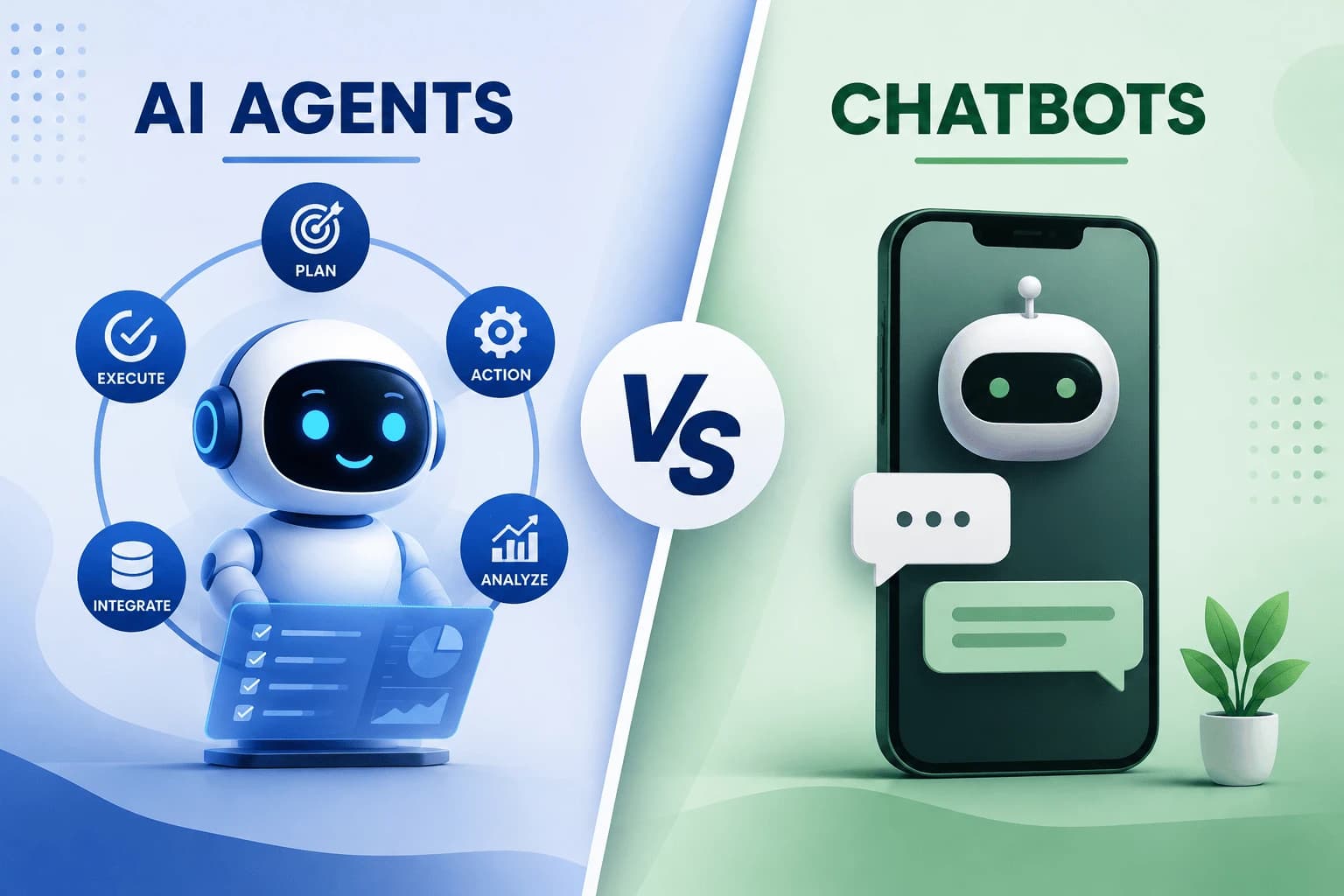
As businesses adopt generative AI, terms such as chatbot, AI assistant, and AI agent are often used interchangeably. But these technologies can work very differently.
A chatbot may answer a question, retrieve information, or guide you through a predefined process.
An AI agent can potentially go a step further: it can understand a goal, decide what actions are needed, use connected tools, and work through a multi-step task.
The simplest way to remember the difference is:
Chatbots primarily communicate. AI agents can take action.
Understanding this difference can help businesses choose the right AI solution instead of spending money on technology that doesn't actually solve the problem.
What Is a Chatbot?
A chatbot is a software system designed to communicate with users through conversation.
Traditional chatbots relied heavily on predefined rules, decision trees, and scripted responses. Modern chatbots can also use large language models (LLMs) to understand questions and generate more natural responses.
However, the basic interaction is usually reactive:
User asks → Chatbot responds → Conversation continues
The chatbot generally waits for the user to provide the next instruction.
What Are Chatbots Good At?
Chatbots are particularly useful when the main requirement is answering questions or guiding users toward existing information.
Common examples include:
Frequently asked questions
Customer support
HR policy questions
Product information
Basic troubleshooting
Appointment guidance
Initial customer enquiry routing
Document and knowledge-base searches
For example, an employee might ask:
"How many paid leave days do I get?"
A chatbot can retrieve the relevant company policy and provide the answer.
If the business only needs information retrieval and basic conversation, a chatbot may be the simplest and most cost-effective solution.
What Is an AI Agent?
An AI agent is designed to work toward a goal rather than simply respond to individual messages.
Instead of only answering:
"What should I do?"
an agent can potentially determine:
"What needs to happen to complete this task?"
For example, imagine telling an AI agent:
"Review last month's failed payments, identify affected customers, check their account history, and prepare personalized retention emails."
That's not a single question.
It's a multi-step workflow.
An AI agent may need to:
Understand the objective
Break the task into smaller steps
Retrieve relevant information
Query databases
Use external APIs
Analyze the results
Adjust its approach if something changes
Produce the final output
This goal-oriented approach is what separates an AI agent from a basic conversational interface.
How Do AI Agents Work?
A simplified AI agent workflow looks like this:
Goal → Planning → Tool Use → Evaluation → Action → Completion
Unlike a simple chatbot, an agent may operate through multiple steps before reaching the final result.
1. Goal Understanding
The agent first identifies what the user wants to accomplish.
2. Planning
It determines what actions may be required to reach the objective.
3. Tool Usage
Depending on its permissions, the agent can interact with external systems such as:
APIs
Databases
CRMs
Search tools
Business applications
Code repositories
4. Evaluation
The system can assess whether the previous action produced the expected result.
5. Adjustment
If something goes wrong, an agent may modify its approach and continue working.
6. Task Completion
The agent stops when the objective is completed or when it reaches a defined limitation.
The source describes this as a continuous perception → reasoning → action cycle rather than a single question-and-answer interaction.
AI Agents vs Chatbots: Key Differences
Feature | Chatbots | AI Agents |
|---|---|---|
Main purpose | Conversation & information | Task execution |
Interaction | Mostly reactive | More goal-driven |
Autonomy | Limited | Higher |
Planning | Usually limited | Multi-step planning |
Tool usage | Basic or limited | Can use multiple tools/APIs |
System access | Usually restricted | Can integrate deeply with systems |
Memory | Often session-based | Can maintain state across workflows |
Best for | FAQs, support, information | Automation and complex workflows |
The key distinction isn't simply whether a system uses AI.
It's what the system is capable of doing after you give it an instruction.
Real-World Example: Customer Support
Let's make the difference easier to understand.
Chatbot
A customer asks:
"Where is my order?"
The chatbot might provide a tracking link or explain how the customer can check the order status.
AI Agent
An AI agent could potentially:
Identify the customer's account
Access the order system
Check the latest shipment status
Review delivery information
Identify a delay
Contact the relevant service through an API
Update the customer
Create a support ticket if necessary
The difference is clear:
The chatbot provides information.
The agent works through the task.
Of course, an agent can only perform these actions if the necessary tools, permissions, integrations, and safeguards have been intentionally provided.
When Should You Use a Chatbot?
A chatbot is often the better choice when your business problem is straightforward.
Consider a chatbot if you need:
FAQ Automation
Answer common questions about products, services, policies, or processes.
Customer Support
Handle basic enquiries before sending more complicated cases to human employees.
Information Retrieval
Help users find information inside approved documents or knowledge bases.
Initial Lead Qualification
Collect basic information and route enquiries to the appropriate team.
Employee Assistance
Answer routine questions about HR policies, procedures, or internal documentation.
If the workflow ends after providing the correct information, there's often no need to introduce a complex autonomous system.
When Should You Use an AI Agent?
AI agents become more interesting when a task involves multiple steps, decisions, tools, and systems.
They may be useful for:
Business workflow automation
Research workflows
Customer-service operations
Data processing
Multi-step reporting
CRM automation
Task management
System-to-system workflows
For example:
"Analyze this week's sales data, identify unusual changes, compare them with last week's results, create a summary, and send it to the sales manager."
This involves multiple actions.
A simple chatbot isn't designed primarily for this type of autonomous workflow.
An agent-based system may be more appropriate.
AI Agents Are More Powerful—but Also More Complex
More autonomy isn't automatically better.
An AI agent with access to business systems can potentially perform valuable actions, but that same access introduces additional risks.
For example, an agent connected to a CRM might be able to update records.
An agent connected to a payment system could potentially trigger financial actions.
An agent with code execution capabilities could potentially modify software.
That's why agentic AI requires careful attention to:
Permissions
Authentication
Monitoring
Testing
Logging
Data protection
Human approval
API access controls
The source specifically warns against giving autonomous agents unrestricted API access without appropriate human-review checkpoints.
Common Mistakes Businesses Make
1. Using an AI Agent for a Simple Problem
If your only requirement is answering:
"What is your return policy?"
you probably don't need a complex autonomous agent.
A well-designed chatbot or knowledge-base assistant may be enough.
Overengineering a simple problem can increase development costs and operational complexity.
2. Expecting a Chatbot to Perform Real Actions
A conversational interface doesn't automatically have permission to modify databases, process refunds, update CRM records, or interact with business systems.
The required tools and permissions must exist behind the interface.
3. Giving Agents Too Much Access
An autonomous system shouldn't automatically receive unrestricted access to every business application.
Use the principle of least privilege:
Give the agent only the permissions it actually needs.
For sensitive workflows, human approval should be required before important actions are executed.
Chatbot or AI Agent: Which Is Better for Your Business?
There is no universal winner.
The right choice depends on your workflow.
Choose a chatbot when:
Users mainly need information
Questions are predictable
The workflow is simple
You want lower complexity
Human employees handle complex cases
Consider an AI agent when:
Tasks involve multiple steps
The system needs to use external tools
Several business systems must interact
The workflow requires decisions
Automation can save significant manual effort
The source makes the same fundamental distinction: chatbots are well suited to information and routine conversations, while agents are better suited to complex tasks involving multiple actions or system integrations.
Can a Chatbot Become an AI Agent?
Not simply by adding a more advanced prompt.
A true agentic system generally requires additional architecture for planning, tool use, state management, and secure integrations.
In other words, moving from chatbot to agent is usually a system-design decision, not just a feature toggle.
Are AI Agents More Expensive?
Generally, they can be.
An AI agent may require:
Multiple model calls
Planning cycles
API requests
Tool execution
Data retrieval
Monitoring
Error handling
Security controls
All of these can increase infrastructure and API costs compared with a simple chatbot interaction.
However, the cost should be evaluated against the value of the workflow being automated.
A more expensive AI system can make sense if it eliminates a large amount of repetitive manual work.
Do You Need Coding Skills to Build an AI Agent?
Not necessarily.
The source notes that low-code agent platforms are increasingly available, allowing non-technical users to create certain AI workflows.
However, advanced agentic applications may still require knowledge of:
APIs
Databases
Authentication
Programming
Workflow automation
Cloud infrastructure
Security
The more sensitive and complex the workflow, the more important technical expertise becomes.
A Smarter Way to Choose Your AI Solution
Before buying or building an AI system, ask one simple question:
"Does my problem require an answer—or an action?"
If you need an answer:
Start with a chatbot.
If you need a multi-step action:
Consider an AI agent.
If you're unsure, start with the simplest solution and expand only when the business requirement justifies it.
The source recommends starting with a chatbot to validate demand before investing in more complex agentic infrastructure.
Frequently Asked Questions
What is the main difference between an AI agent and a chatbot?
A chatbot primarily focuses on conversation and information retrieval, while an AI agent can pursue a goal by planning actions, using tools, and completing multi-step workflows.
Are AI agents better than chatbots?
Not always.
A chatbot can be the better option for simple information-based tasks. AI agents become more useful when the workflow requires multiple actions, decisions, or system integrations.
Can an AI chatbot perform actions?
It can, but only when the underlying system provides the necessary integrations and permissions. Simply having a conversational interface doesn't automatically make a system an autonomous agent.
Are AI agents safe?
They can be useful when properly designed, but greater autonomy creates additional risks. Strong permissions, monitoring, testing, data protection, and human approval are important considerations.
Are AI agents expensive?
They can cost more than simple chatbot systems because autonomous workflows may involve multiple model calls, API requests, tool usage, and evaluation steps.
Final Thoughts
The difference between AI agents and chatbots becomes much easier to understand when you focus on what each system is designed to accomplish.
A chatbot is primarily built to talk, answer, explain, and guide.
An AI agent can go further by pursuing a goal, planning actions, using tools, and working through a multi-step process.
But more autonomy doesn't automatically mean better technology.
Sometimes the smartest decision is to use a simple chatbot.
Before choosing an AI solution, ask:
What does it need to do?
What systems will it access?
What actions can it take?
What happens if it makes a mistake?
How much human control is required?
The right AI solution isn't the one with the most impressive features.
It's the one that solves the actual business problem with the right level of complexity and control.
Written by
Praxiaskill
Last updated
29 August 2026
