
AI Hallucinations Explained: Why AI Gives Wrong Answers
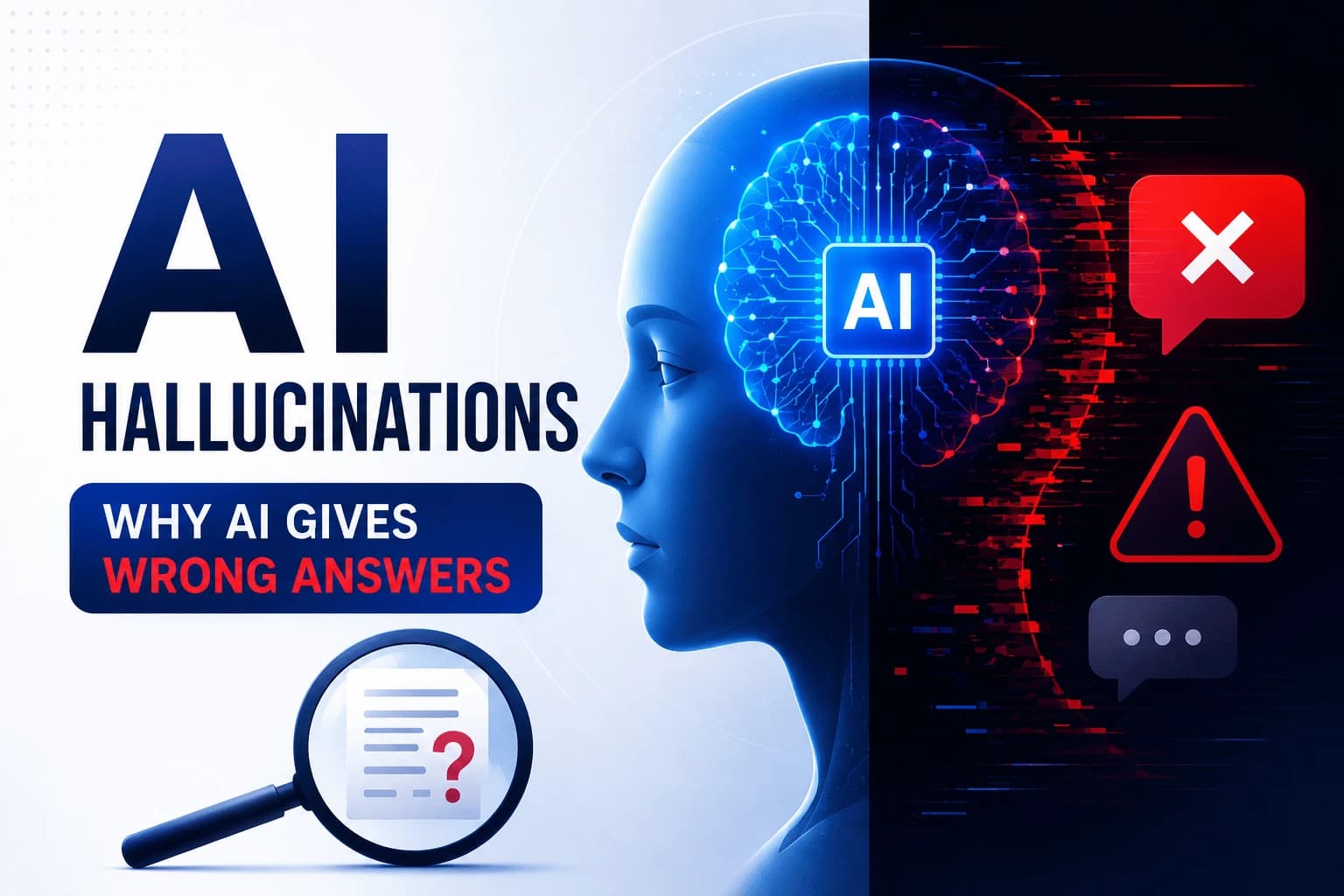
Artificial intelligence can answer a complicated question in seconds. It can write an article, explain a technical concept, create code, summarize a report, or analyze information with impressive confidence.
But there's a problem.
AI can be completely wrong while sounding completely right.
A spelling mistake is usually easy to spot. An invented statistic, fake citation, incorrect date, or made-up explanation can be much harder to recognize because the response may look polished and professional.
This is known as an AI hallucination.
Understanding why AI hallucinations happen—and how to identify them—is becoming increasingly important for students, professionals, researchers, content creators, and businesses using generative AI.
The most important rule to remember is simple:
A fluent AI answer is not automatically a factual AI answer.
What Is an AI Hallucination?
An AI hallucination is false, unsupported, or inconsistent information generated by an artificial intelligence system.
The answer may sound logical and contain convincing details, but the underlying information may not be supported by reliable evidence.
For example, an AI might:
Invent a research paper that doesn't exist
Provide a fake citation
Attribute a quote to the wrong person
Give an incorrect statistic
Create a fictional historical event
State an outdated fact as current
Produce incorrect technical information
This is why AI-generated information should be treated differently depending on its purpose.
If you're asking AI for ten creative blog ideas, an incorrect answer may not matter much.
If you're using AI to research medical, legal, financial, academic, or business information, verification becomes much more important.
Why Does AI Hallucinate?
To understand AI hallucinations, it helps to understand how large language models work.
An AI language model doesn't function like a traditional search engine or a verified encyclopedia.
It generates text by recognizing patterns learned during training and predicting what information should come next.
This allows AI to produce remarkably natural language, but it doesn't mean that every generated statement has been checked against reality.
When the model doesn't have enough reliable information, it can still produce a plausible continuation instead of simply stopping.
That's one reason an AI can give you a detailed answer even when the underlying information is incorrect.
4 Common Causes of AI Hallucinations
1. Lack of Built-In Fact Verification
A language model doesn't automatically verify every claim it generates against an authoritative source.
Information that appeared frequently in training data can influence the model's output even when that information is inaccurate.
The result can be a response that sounds certain without actually being verified.
2. Noisy or Conflicting Training Data
AI models learn from very large datasets, and those datasets can contain errors, contradictions, low-quality information, and misleading patterns.
If incorrect information appears in the material used to train a model, the model may reproduce similar patterns.
This doesn't mean the AI intentionally lies. It means the system can generate an incorrect answer based on patterns that don't reliably represent reality.
3. Vague Questions
The way you ask a question matters.
A vague or ambiguous prompt can leave important details undefined. The AI may then make assumptions and fill in the missing information with something that sounds reasonable.
For example, instead of asking:
"What happened with the company's policy?"
you might get a better result by specifying:
"What is the company's current refund policy as published on its official website?"
More precise questions reduce unnecessary assumptions.
4. Difficult or Missing Information
AI hallucinations become more likely when the model has limited information about a niche topic, a recent event, or a highly specific request.
Outdated knowledge can also become a problem when you're asking about information that changes frequently.
Missing information, ambiguous prompts, outdated knowledge, and difficult reasoning tasks can all increase hallucination risk.
Real-World Examples of AI Hallucinations
AI hallucinations aren't just theoretical problems.
They can have real consequences.
Fake Legal References
There have been cases where lawyers submitted legal documents containing fabricated case references generated by AI.
This demonstrates why high-stakes professional work requires human verification.
Invented Biographies
AI systems can sometimes generate incorrect information about public figures, researchers, authors, or professionals—including books, awards, qualifications, or achievements that never existed.
These examples show why "the AI said it" is not sufficient evidence.
Why Professional-Looking AI Answers Can Be Dangerous
One of the easiest mistakes is judging an AI answer by how professional it looks.
A response may contain:
Perfect formatting
Headings
Bullet points
Technical vocabulary
Statistics
Citations
Confident language
None of these guarantee accuracy.
Good presentation does not equal good evidence.
This is particularly important when AI-generated information is being copied into reports, blogs, presentations, academic work, or business documents.
How to Detect AI Hallucinations
You don't need to fact-check every single sentence with the same level of effort.
Instead, pay particular attention to claims that could cause problems if they are wrong.
Check Important Claims Against Reliable Sources
When an AI gives you a statistic, date, quotation, legal reference, research finding, or technical claim, verify it independently.
Prefer:
Official government sources
Original research papers
Official company documentation
Regulatory bodies
Primary sources
Reputable professional organizations
Don't simply trust a citation because it looks real.
Open it and check what it actually says.
The source recommends paying particular attention to dates, statistics, quotations, names, and citations when verifying AI-generated information.
How Can You Reduce AI Hallucinations?
You can't completely eliminate AI hallucinations, but you can reduce their frequency and impact.
1. Use RAG for External or Private Knowledge
Retrieval-Augmented Generation (RAG) allows an AI application to retrieve relevant information from an external knowledge source before generating an answer.
For example, a company can connect an AI assistant to its approved documentation and internal knowledge base.
This gives the model relevant source material instead of relying entirely on its learned patterns.
RAG can reduce certain factual errors, but it doesn't guarantee perfect answers. The retrieved information itself still needs to be reliable and relevant.
2. Tell the AI When Not to Guess
Your instructions can explicitly tell an AI system to avoid inventing information.
For example:
"If the provided information does not support an answer, say that the information is unavailable instead of guessing."
This doesn't make hallucinations impossible, but it creates a useful guardrail for document-based and business AI workflows.
3. Break Down Complex Problems
For complicated calculations or reasoning-heavy tasks, don't blindly accept the final answer.
Ask the system to provide a concise explanation of its approach, then independently verify the important steps.
For numerical work, use a calculator or another reliable method whenever accuracy matters.
The goal isn't simply to get a longer AI response.
The goal is to make verification easier.
Can AI Hallucinations Be Completely Eliminated?
No.
AI developers and researchers continue to work on methods for detecting and reducing hallucinations, but factual errors remain a known limitation of generative AI systems.
This is why responsible AI use requires more than choosing a powerful model.
It also requires:
Good prompts + reliable sources + testing + human judgment
How to Use AI Without Blindly Trusting It
AI can still be incredibly useful.
You can use it to:
Brainstorm ideas
Explain difficult concepts
Summarize information
Organize research
Generate first drafts
Explore different perspectives
Speed up repetitive work
The problem isn't using AI.
The problem is treating AI output as unquestionable evidence.
For important information, build verification into your workflow.
A simple process is:
Ask → Review → Verify → Use
That extra verification step can prevent a convincing AI mistake from becoming a published or business-critical error.
Frequently Asked Questions
What is an AI hallucination?
An AI hallucination is false, unsupported, or inconsistent information generated by an AI system, often presented in a convincing way.
Why does AI hallucinate?
AI generates probable text based on learned patterns rather than guaranteeing factual truth. Missing information, vague prompts, outdated knowledge, and difficult tasks can increase the risk of incorrect answers.
Does RAG prevent AI hallucinations?
No. RAG can reduce some factual errors by providing relevant external information, but retrieval quality and the AI's interpretation of that information still matter.
How can I check whether an AI answer is correct?
Identify the important claims and verify them against reliable, preferably primary or authoritative sources. Pay special attention to statistics, dates, quotations, names, and citations.
Are AI hallucinations a reason to stop using AI?
No.
AI remains extremely useful for research, brainstorming, writing, analysis, and productivity. The better approach is to understand its limitations and verify important information before relying on it.
Final Thoughts
AI is exceptionally good at producing language that sounds plausible.
But plausible isn't the same as proven.
That's the central lesson behind AI hallucinations.
You don't need to stop using generative AI. You simply need to use it with a more critical mindset.
When an AI gives you an important claim, ask:
"How do I know this is true?"
Then check the evidence.
That one habit can make the difference between using AI intelligently and unknowingly spreading information that was never correct in the first place.
Written by
Praxiaskill
Last updated
28 August 2026
