
AI Hallucinations: How Developers Can Reduce Them
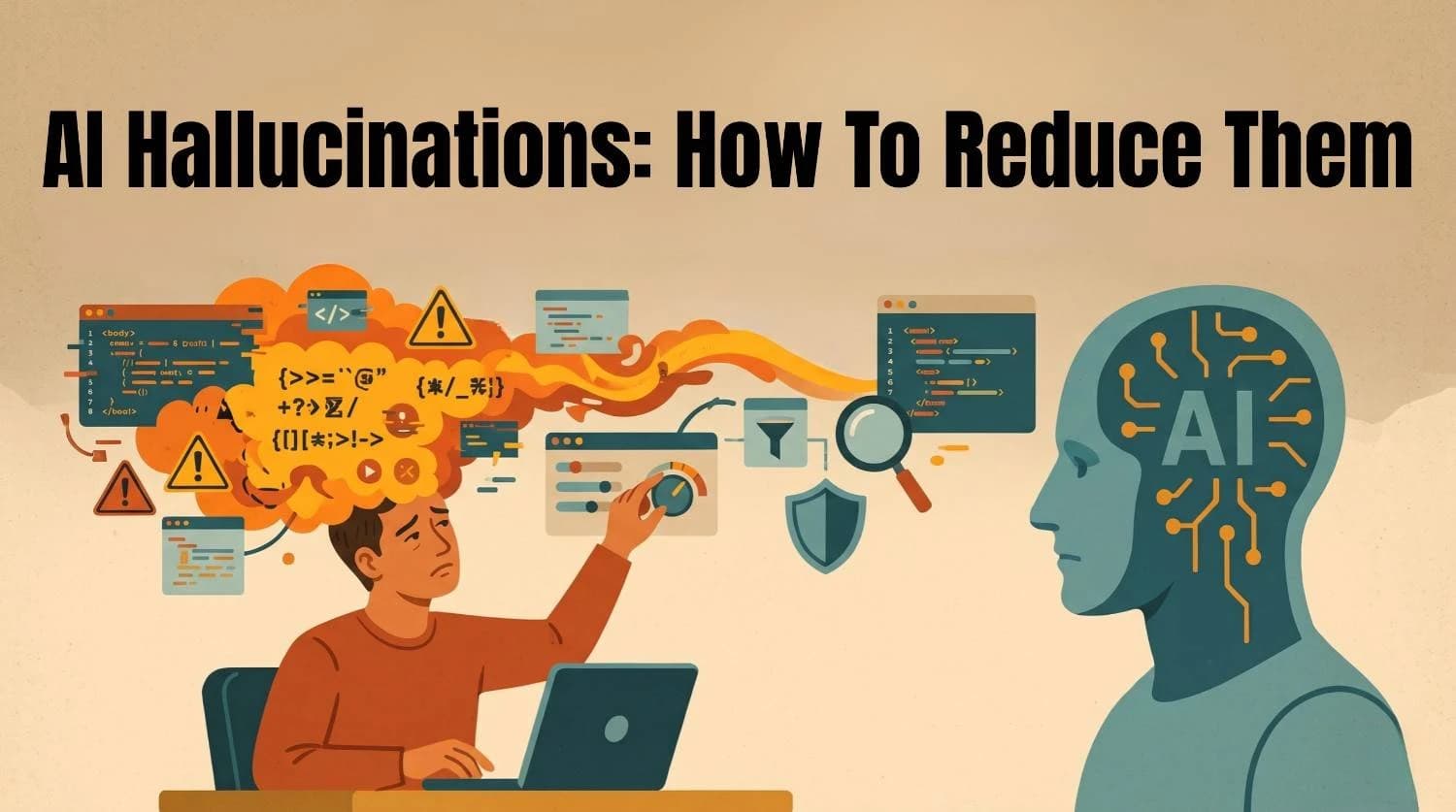
An AI chatbot can produce a convincing answer, complete with technical explanations and references, yet still be completely wrong. This is one of the biggest challenges developers face when building applications powered by Large Language Models (LLMs).
These errors are known as AI hallucinations. They can affect everything from customer support chatbots and coding assistants to enterprise search platforms and automated decision-making systems.
For developers, the challenge is not simply making an AI model generate better responses. It is designing an application that can recognize missing information, retrieve reliable evidence, verify generated claims and avoid presenting uncertain answers as facts.
Understanding how AI hallucinations occur and implementing the right mitigation techniques can significantly improve the reliability of generative AI applications.
AI hallucinations occur when a generative AI model produces information that is incorrect, fabricated, misleading or unsupported by available evidence.
Unlike traditional software bugs, these errors do not always produce obvious failures. An application might execute successfully while the model returns an inaccurate explanation, invents an API method or cites a research paper that does not exist.
For example, a developer might ask an AI coding assistant to recommend a function from a particular JavaScript library. Instead of acknowledging that the function is unavailable, the model could generate a plausible-looking method name and provide working-looking code around it.
The problem arises because language models generate responses by learning patterns from training data and predicting likely sequences of tokens. Generating a convincing sentence does not necessarily mean the model has verified its factual accuracy.
The US National Institute of Standards and Technology (NIST) describes this phenomenon as confabulation in its Generative AI Risk Management Framework. It highlights the risks of confidently presenting erroneous information, particularly in consequential applications.
AI hallucinations are not caused by a single technical limitation. Several factors can contribute to inaccurate outputs.
Incomplete or Outdated Training Data
LLMs learn from large datasets containing information available during their training process. If a model lacks knowledge about a recent software release, updated documentation or a newly introduced framework feature, it may generate an answer based on outdated patterns.
This becomes particularly problematic when developers use AI for rapidly changing technologies, including cloud platforms, programming frameworks and API integrations.
Ambiguous Prompts and Missing Context
Poorly structured instructions can encourage models to make assumptions.
For example, asking an AI system to generate a database query without specifying the database engine, table structure or expected output leaves important details undefined.
The model may fill those gaps with assumptions rather than asking for clarification.
Weak Retrieval and Irrelevant Information
AI applications that use external documents can still hallucinate when their retrieval systems return irrelevant, incomplete or conflicting information.
Even if the correct information exists in a knowledge base, poor search results can prevent the model from accessing it.
Overconfidence in Generated Responses
Language models can produce confident statements without having reliable evidence for them. This makes hallucinations difficult to identify through ordinary user interactions.
A response that sounds technically sophisticated should never automatically be treated as accurate.
Reducing AI hallucinations requires multiple layers of control rather than relying on a single prompt or model setting.
Use Retrieval-Augmented Generation (RAG)
Retrieval-Augmented Generation (RAG) is one of the most practical approaches for improving factual accuracy in knowledge-intensive AI applications.
Instead of relying exclusively on information learned during training, a RAG system retrieves relevant information from external sources before generating a response.
A typical RAG workflow includes:
Store trusted documents in a searchable knowledge base.
Convert document sections into embeddings.
Retrieve relevant passages when a user submits a question.
Provide the retrieved information as context to the LLM.
Generate an answer based on the available evidence.
For example, a customer support chatbot can retrieve information from official product manuals, updated pricing documents and company policies before answering questions.
However, RAG is not a complete solution. Incorrect retrieval, outdated documents and conflicting sources can still produce misleading answers. Developers must evaluate retrieval quality alongside generation quality.
Write Clear and Structured Prompts
Prompt engineering helps developers define how a model should interpret instructions and respond to users.
A good system prompt should specify the model's role, available information, response requirements and limitations.
For example:
You are a technical support assistant.
Answer using only the supplied documentation.
If the documentation does not contain the
required information, state that the answer
cannot be verified.
Do not invent API methods, specifications,
references or technical details.
Provide supporting source references
where available.
This approach establishes clear boundaries and discourages unsupported answers.
Developers should also provide relevant examples when consistent response formatting or task-specific behavior is required. Google's prompt engineering guidance highlights the value of clear instructions, structured context and examples.
For applications involving technical, financial or business information, developers should prioritize authoritative data sources.
Depending on the use case, these may include:
Official API documentation.
Verified company knowledge bases.
Government publications.
Approved internal databases.
Maintained technical repositories.
For instance, a coding assistant should retrieve information from the relevant framework's official documentation rather than depending entirely on potentially outdated training knowledge.
This technique, known as grounding, connects generated responses to verifiable information and reduces dependence on unsupported model assumptions.
AI-generated responses should pass through validation before reaching users or triggering application actions.
Developers can implement a verification layer that checks whether important claims are supported by retrieved information.
For example, an AI-generated answer might contain three factual claims. A verification process can evaluate each claim against its supporting source and flag unsupported statements.
Useful validation methods include:
Checking whether citations point to existing documents.
Comparing generated facts against trusted database records.
Validating numerical values against source data.
Checking structured outputs against predefined schemas.
Rejecting responses that fail essential verification rules.
For high-impact applications, automated verification should be combined with human review.
One common mistake in AI application development is requiring a model to answer every question.
Developers should explicitly allow the system to acknowledge when information is unavailable or insufficient.
For example, instead of generating a speculative answer, an AI assistant could respond:
"I couldn't verify this information using the available documentation. Please consult the official technical reference."
This is particularly useful for customer support, legal information systems and technical troubleshooting tools.
Anthropic's official developer documentation also recommends allowing uncertainty, grounding claims in direct quotations and verifying responses with citations.
Testing only a few successful prompts is not enough to establish whether an AI application is reliable.
Developers should build evaluation datasets containing realistic questions, expected answers, incomplete information, ambiguous requests and deliberately misleading inputs.
Useful evaluation dimensions include:
Factual correctness: Is the generated information accurate?
Faithfulness: Does the response follow the supplied evidence?
Retrieval relevance: Did the system retrieve the correct information?
Citation accuracy: Do the references support the associated claims?
Abstention quality: Does the model avoid answering when evidence is insufficient?
These evaluations should be repeated whenever developers change prompts, models, retrieval settings or source documents.
OpenAI's LLM accuracy guidance recommends an iterative process of evaluation, diagnosis and optimization rather than adopting complex techniques without identifying the actual failure.
Not every AI-generated response should be trusted to operate independently.
Applications involving financial transactions, healthcare information, legal guidance, security operations or other consequential decisions need stronger verification and human oversight.
Developers should establish review thresholds based on the potential consequences of an incorrect response.
For example, an AI system might automatically summarize a financial report but require an authorized employee to approve any transaction-related recommendation.
Human oversight does not eliminate hallucinations, but it provides an additional control before potentially harmful information or actions reach users.
Relying entirely on prompt engineering: Good instructions cannot compensate for missing or incorrect information.
Assuming RAG guarantees accuracy: Poor retrieval can introduce additional errors.
Ignoring outdated knowledge bases: Old documents can produce outdated responses even when the retrieval pipeline works correctly.
Skipping evaluation after updates: Changes to models, prompts and data sources can introduce new failures.
Treating citations as proof: A generated citation must be checked against the actual source.
Allowing unrestricted AI actions: Validate outputs and enforce permissions before executing sensitive operations.
Start with a measurable accuracy baseline before introducing complex mitigation techniques.
Separate retrieval failures from generation failures when investigating incorrect answers.
Monitor hallucination patterns using production feedback and representative evaluation datasets.
Use source attribution to make important AI-generated claims independently verifiable.
Match verification requirements to the business impact of incorrect information.
1. What causes AI hallucinations?
AI hallucinations can result from incomplete training data, ambiguous prompts, missing context, weak retrieval systems and limitations in how language models generate responses. They occur when models produce plausible information without sufficient factual support.
2. Can developers completely eliminate AI hallucinations?
No. Current mitigation techniques can reduce hallucinations, but they cannot guarantee that every generated response will be accurate. Developers should combine grounding, verification, evaluation and human oversight.
3. How does RAG reduce AI hallucinations?
RAG retrieves relevant information from external knowledge sources and supplies it to the language model before response generation. This helps the model produce answers grounded in available evidence instead of relying exclusively on learned information.
4. Does prompt engineering prevent AI hallucinations?
Prompt engineering can reduce certain errors by providing clear instructions, relevant context and permission to acknowledge uncertainty. However, it cannot independently guarantee factual accuracy or compensate for unreliable source information.
5. How can developers detect AI hallucinations?
Developers can detect hallucinations through factual verification, citation checking, retrieval evaluation, automated testing and human review. Comparing generated claims against trusted reference information is particularly useful.
AI hallucinations remain a significant challenge for developers building reliable generative AI applications. Although language models can produce impressive responses, fluency and confidence do not guarantee factual correctness.
The most effective approach is to build reliability into the entire application architecture. RAG can provide relevant evidence, structured prompts can establish clear boundaries, verification layers can identify unsupported claims, and continuous evaluation can reveal weaknesses before they become production problems.
Developers should also recognize that different applications require different levels of accuracy and oversight. A chatbot generating general explanations has different reliability requirements from an AI system handling financial or security-related decisions.
Ultimately, the goal should not be to make AI answer every question. It should be to build systems that provide supported answers, recognize uncertainty and know when human intervention is necessary.
Written by
Alaffiya Madarwala
Last updated
19 November 2026
