
Career Planning in the Age of AI - A Student Guide
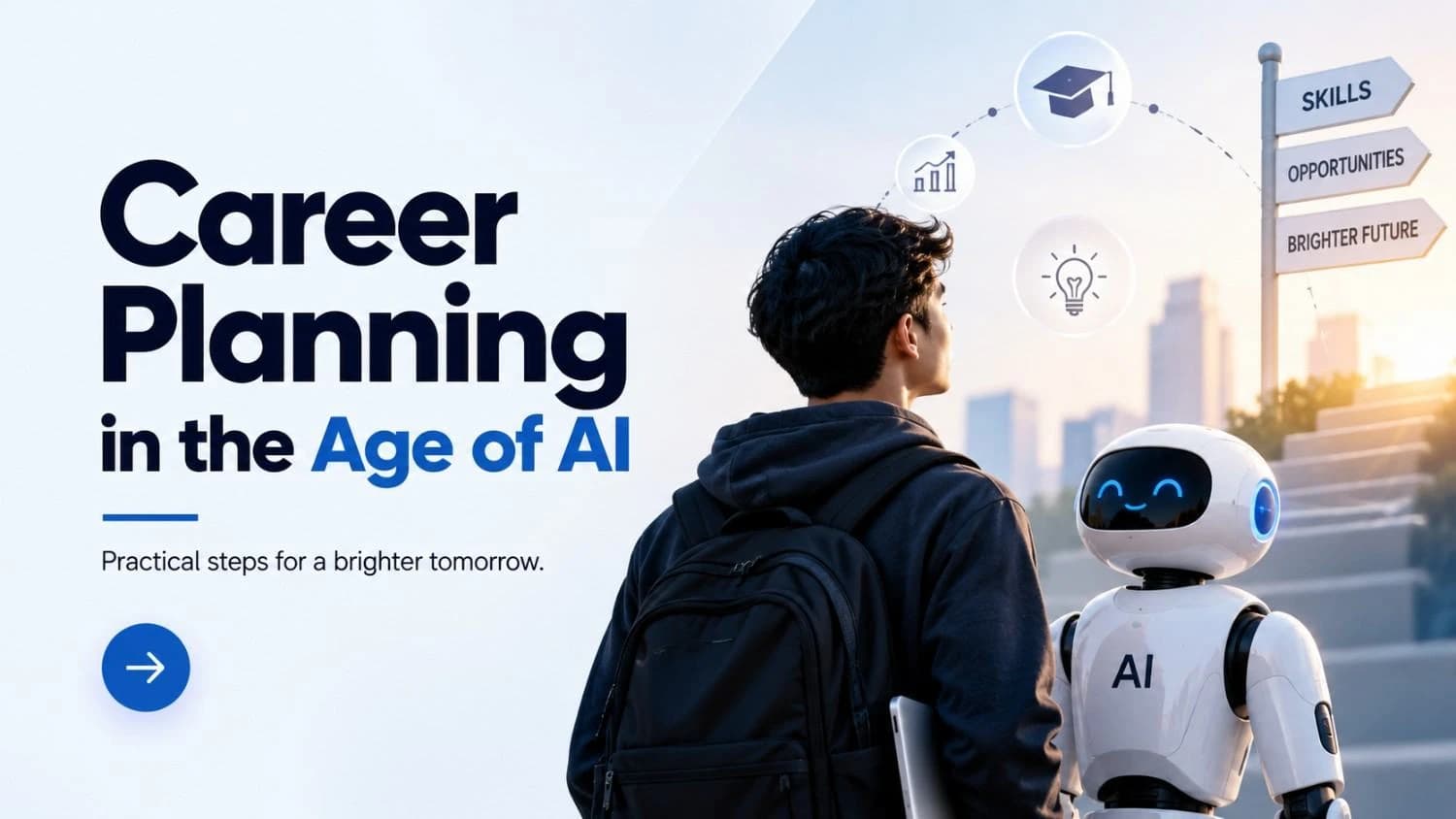
Career Planning in the Age of AI: A Student Guide
Imagine spending years preparing for a career, only to enter the workplace and discover that AI can now handle some of the tasks you expected to do yourself.
For many students, that thought can be unsettling. But AI is not simply about replacing jobs. It is changing how work is done, which skills employers value, and what students need to prepare for their careers.
The better question is not, “Which job will AI never replace?”
Instead, ask:
“How can I become valuable in a workplace where AI is part of the job?”
That mindset can make career planning much more practical and future-focused.
How AI Is Changing Career Planning
Traditional career planning often followed a predictable path: choose a subject, earn a qualification, find a related job, and gradually gain experience.
That approach still has value, but technology has made career development less predictable.
AI is already influencing areas such as marketing, finance, software development, education, healthcare, customer service, research, and business operations. As repetitive tasks become easier to automate, professionals are increasingly expected to combine technology with skills such as communication, analysis, creativity, and decision-making.
For students, this means choosing a career should not be about finding one perfect job title. It should be about developing a strong set of transferable skills that can remain useful even when roles and technologies change.
Don't Search for a Completely “AI-Proof” Career
Many students want to know which careers are safe from AI. The reality is that no career can be guaranteed to remain unchanged.
Even professions that appear secure today may look different in the future.
Rather than trying to avoid AI, learn how to work alongside it.
For example, an accountant who understands AI-assisted analysis may be able to work more efficiently than someone who refuses to use new technology. Similarly, a marketer who combines creativity, customer understanding, analytics, and AI tools can bring more value than someone who depends entirely on manual processes.
The goal is not to beat AI at the tasks it performs well.
The goal is to develop strengths that require human judgment, context, creativity, responsibility, communication, and problem-solving while learning how technology can support your work.
Build a Skill Portfolio, Not Just a Job Title
Instead of saying, “I want to become a digital marketer,” think about what you actually need to become good at that career.
Your skill set might include:
Marketing fundamentals
SEO
Content creation
Consumer research
Analytics
Communication
AI-assisted workflows
Problem-solving
This approach gives you more career flexibility. If a particular job title changes, your underlying skills can still help you move into related roles.
A useful career plan should therefore focus on what you can learn and demonstrate, rather than only the position you eventually want to hold.
Combine Technical Skills With Human Skills
Learning an AI tool is useful. Understanding its limitations is even more important.
Students should develop basic AI literacy while continuing to strengthen skills such as critical thinking, communication, teamwork, creativity, research, and decision-making.
Think of these as complementary skills rather than separate choices.
For example, a business student could combine Excel, data analytics, AI tools, presentation skills, and business communication. A computer science student could combine programming and AI knowledge with system design, teamwork, communication, and problem-solving.
A strong career profile is rarely based on technical knowledge alone.
It is the combination of technical ability + human judgment + practical application that can make a candidate stand out.
Turn Learning Into Real-World Experience
One of the biggest mistakes students make is collecting certificates without actually applying what they learn.
Completing another course can feel productive, but employers also want evidence that you can use your knowledge to solve problems.
Start building projects.
You could analyse a real dataset, create a marketing campaign, design a website, develop a simple application, automate a repetitive process, research a business problem, or help a small organisation improve its digital presence.
Then document your work.
Explain:
What problem did you solve?
What tools did you use?
What decisions did you make?
What challenges did you face?
What was the result?
A certificate proves that you completed learning.
A project can demonstrate how you think, how you work, and what you can actually do.
Use AI Without Becoming Dependent on It
AI can be a powerful learning and career tool.
Students can use it to explore industries, generate project ideas, practise interviews, understand difficult concepts, improve writing, analyse information, and receive feedback.
However, there is an important distinction between using AI to learn and using AI to avoid learning.
If AI completes every assignment, research task, or problem for you, you may become faster without becoming more capable.
Instead, use AI to challenge your thinking. Ask for alternative solutions, counterarguments, practice questions, explanations, or feedback. Then verify important information and make your own decisions.
The objective should be to become someone who knows when and how to use AI effectively, rather than someone who cannot work without it.
Review Your Career Plan Regularly
Your career plan should not be something you create once and forget.
Review it regularly, ideally every semester.
Ask yourself:
What skills are becoming more valuable in my industry?
Which skills can I actually demonstrate?
What technologies are changing my chosen field?
What type of work do I enjoy enough to keep improving at?
What evidence can I show a potential employer?
This creates a useful cycle:
Learn → Practise → Build → Reflect → Improve
You don't need to predict exactly what the job market will look like ten years from now. You need to become adaptable enough to respond when it changes.
Keep a Career Evidence Folder
Start saving your best work in one organised place.
Include projects, presentations, internship work, certificates, competition results, writing samples, designs, dashboards, positive feedback, and other achievements.
This becomes your personal career evidence folder.
When an internship or job opportunity appears, you won't have to rely only on your CV or try to remember everything you've accomplished. You'll already have examples that demonstrate your abilities.
It can also make interviews easier because you can answer questions using real experiences instead of simply saying, “I am hardworking” or “I am a quick learner.”
Common Career Planning Mistakes to Avoid
Avoid trying to predict the exact jobs of the future. Technology changes too quickly for anyone to make perfect predictions.
Don't chase every new AI tool either. Tools will continue to change. Focus on transferable skills, concepts, and workflows.
Most importantly, don't ignore the fundamentals. Writing, communication, analytical thinking, research, business knowledge, creativity, and problem-solving remain valuable.
And remember: certificates without application have limited value. Whenever possible, turn what you learn into something you can demonstrate.
Frequently Asked Questions
How should students plan their careers in the age of AI?
Students should develop a combination of technical and human skills, gain practical experience, learn AI fundamentals, build projects, and regularly review changes in their chosen industry.
Which skills are important for students in the AI era?
AI and digital literacy are increasingly useful, but students should also develop analytical thinking, creativity, communication, teamwork, adaptability, resilience, and problem-solving.
Will AI replace future jobs?
AI is expected to automate some tasks and change many occupations, but its impact will vary between industries and roles. Students should prepare for collaboration between people and technology rather than assume every job will simply disappear.
Does every student need to become an AI expert?
No. Every student does not need to become an AI engineer. However, basic AI literacy can help students understand how technology affects their industry and use AI tools responsibly and effectively.
Conclusion
Career planning in the age of AI is not about predicting the future perfectly. It is about preparing yourself to adapt when the future changes.
Technology will continue to influence jobs, workflows, and required skills. Students who ignore these changes may struggle to keep up, while those who chase every new technology may quickly become overwhelmed.
A smarter approach is to build a balanced foundation.
Learn relevant technology. Understand your industry. Strengthen your fundamentals. Develop communication, creativity, critical thinking, and problem-solving skills. Most importantly, create real evidence of what you can do.
Your first career choice may not be your final destination—and that's completely normal.
The ability to keep learning, adapting, and improving can become one of the most valuable parts of your career plan.
Written by
Praxiaskill
Last updated
14 September 2026
