
Fine-Tuning vs RAG: Which AI Approach Should You Use?
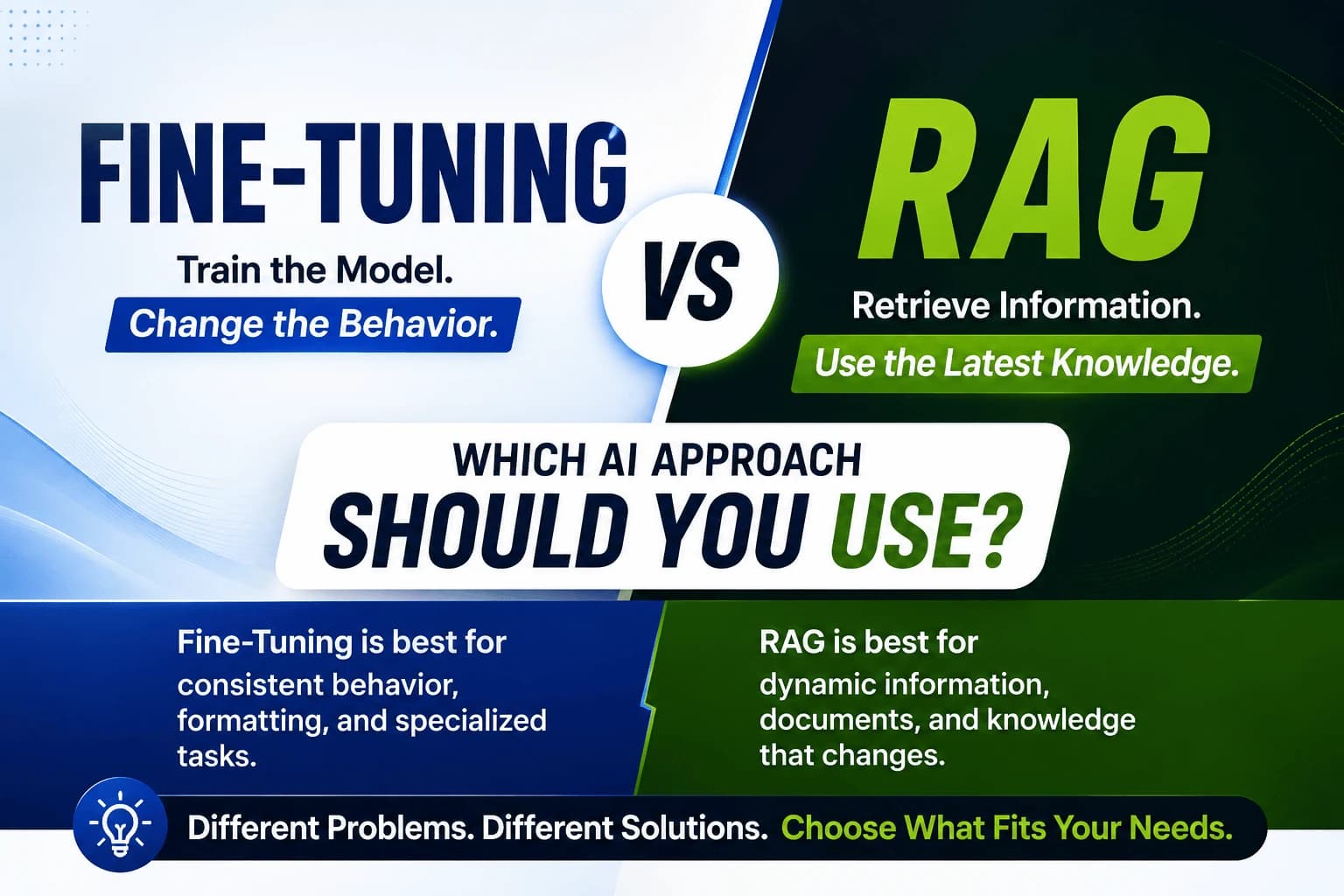
Building a custom AI application sounds exciting until you reach an important question:
Should you use RAG, fine-tuning, or both?
This decision matters because these two approaches solve different problems.
If your AI gives outdated answers because it cannot access your latest company documents, fine-tuning may not be the answer. On the other hand, if your AI knows the information but consistently struggles to follow a specific format, tone, or task pattern, simply adding more documents may not solve the problem.
Understanding the difference between RAG and fine-tuning can help you choose the right architecture, control costs, and avoid unnecessary development work.
The easiest way to remember the difference is:
RAG improves what the AI can access.
Fine-tuning changes how the AI behaves.
Let's break down the difference in simple terms.
RAG vs Fine-Tuning: What's the Real Difference?
Before looking at the technology, think about two different problems.
Problem 1: The AI Doesn't Have the Right Information
Suppose your company updates its return policy every few months.
Your AI assistant needs to answer questions using the latest policy, but the model doesn't automatically know about every update.
This is a knowledge problem.
RAG can help because it retrieves the latest information from your connected knowledge base and gives it to the AI when needed.
Problem 2: The AI Knows What to Say but Doesn't Follow Your Required Format
Now imagine your AI already has the necessary information, but you need every response to follow a strict JSON structure.
Or perhaps your business needs responses to consistently follow a particular writing style.
This is a behavior problem.
Fine-tuning may be more appropriate because the goal is to make the model perform a particular task in a more consistent way.
So the basic rule is:
Missing knowledge? Think RAG.
Inconsistent behavior? Consider fine-tuning.
What Is RAG?
RAG stands for Retrieval-Augmented Generation.
RAG allows an AI system to retrieve relevant information from an external knowledge source before generating an answer.
Think of it like an open-book exam.
Instead of asking the AI to remember everything, you give it access to the relevant information when the question is asked.
A typical RAG system can:
Receive a user's question.
Search a document collection or vector database.
Find relevant information.
Add that information to the model's context.
Generate an answer based on the retrieved content.
For example, a company's customer support AI could search product manuals, FAQs, and internal policies before answering a customer.
This makes RAG particularly useful when information changes regularly or when users need answers connected to specific documents.
When Should You Use RAG?
RAG is generally a strong option when your AI needs access to information that changes over time.
Consider RAG when you need:
Current information
Private company documents
Large document collections
Document-based question answering
Internal knowledge assistants
Customer support knowledge bases
Search systems
Answers that can be connected to source documents
Example: Changing Company Policies
Imagine an e-commerce company changes its refund policy.
With a RAG system, the updated policy can be added to the knowledge base.
The AI can then retrieve the new policy when answering customer questions.
You don't necessarily need to retrain the underlying model every time a document changes.
This is one of the biggest practical advantages of RAG for dynamic information.
What Is Fine-Tuning?
Fine-tuning involves taking a pretrained AI model and training it further using a carefully prepared dataset of examples.
The goal isn't simply to give the model more information.
Instead, fine-tuning can help the model learn a particular behavior, output pattern, style, or specialized task.
For example, you may want a model to:
Consistently produce a specific JSON format
Follow a particular response structure
Use specialized terminology
Maintain a specific brand voice
Perform a narrow classification task
Handle a specialized workflow more consistently
In these situations, the challenge isn't necessarily that the model lacks information.
The challenge is that you want the model to behave in a particular way.
The source describes fine-tuning as continued supervised training that changes the model's internal weights to improve specialized behavior and output consistency.
When Should You Use Fine-Tuning?
Fine-tuning makes more sense when you have a clearly defined task and want consistent model behavior.
For example, imagine a company receives thousands of customer messages and wants every message classified into one of ten predefined categories.
If the model repeatedly struggles with the classification task despite good prompting and examples, fine-tuning could be worth considering.
The key question is:
"Do I need this model to perform a specific task in a specific way?"
If the answer is yes, fine-tuning becomes more relevant.
It is less suitable when your main problem is constantly changing factual information.
RAG vs Fine-Tuning: A Simple Comparison
Factor | RAG | Fine-Tuning |
|---|---|---|
Main purpose | Improve access to information | Improve behavior or task performance |
Changing information | Strong fit | Poorer fit |
Private documents | Strong fit | Not the primary purpose |
Specific response format | Limited | Stronger fit |
Brand style | Limited | Stronger fit |
Document-based Q&A | Strong fit | Not the main use case |
Knowledge updates | Update the knowledge base | May require additional training |
Training requirement | No model retraining required for each update | Requires training process |
Retrieval required | Yes | No |
Best for | Dynamic knowledge | Consistent specialized behavior |
The most important point is that RAG and fine-tuning aren't direct replacements for one another.
They address different problems.
Cost, Speed, and Maintenance
The technical choice also affects your application's cost and maintenance requirements.
RAG Costs
A RAG system requires components such as:
Document processing
Chunking
Embeddings
Vector storage
Retrieval
Context processing
The system also adds retrieved information to the model's input, which can increase token usage and response latency.
Fine-Tuning Costs
Fine-tuning requires:
A high-quality training dataset
Data preparation
Training resources
Evaluation
Model monitoring
There is also an ongoing maintenance consideration: if the underlying factual information changes significantly, a fine-tuned model may need another training cycle.
The source highlights these differences across upfront costs, runtime overhead, and maintenance requirements.
Which Is Cheaper: RAG or Fine-Tuning?
There isn't a universal answer.
RAG avoids the cost of repeatedly training a model when documents change, but it introduces retrieval and context-processing costs for individual requests.
Fine-tuning requires more investment during training, but depending on the application, it can sometimes reduce the amount of contextual information that needs to be sent with every request.
So instead of asking:
"Which technology is cheaper?"
ask:
"Which approach solves my actual problem with the least unnecessary complexity?"
The source also notes that the cost difference depends heavily on the application and how the system is deployed.
Can You Use RAG and Fine-Tuning Together?
Yes.
In fact, some applications can benefit from using both.
Imagine an AI customer-support system that needs to:
Access the latest product documentation
Follow a strict response structure
Maintain a consistent brand tone
RAG can provide the current product information.
Fine-tuning can help improve the model's desired behavior and output style.
This creates a hybrid architecture:
Fine-Tuning → Specialized Behavior
RAG → Current Knowledge
The two technologies can complement each other rather than compete with each other.
Try Prompt Engineering Before Fine-Tuning
Before investing in fine-tuning, test whether better prompting can solve the problem.
Sometimes an AI system performs poorly simply because the instructions are unclear.
Try improving:
System instructions
Examples
Output formats
Constraints
Context
Workflow design
If better prompting solves the problem, you may not need either RAG or fine-tuning.
The source recommends considering prompt engineering before moving toward a more complex architecture.
Common Mistakes to Avoid
1. Using Fine-Tuning to Keep Information Fresh
If your product catalog or company policies change frequently, repeatedly fine-tuning the model is usually the wrong way to handle the problem.
Use a retrieval-based approach when the core requirement is access to changing information.
2. Underestimating Training Data Preparation
Fine-tuning isn't simply about collecting a large number of examples.
The quality, consistency, labeling, and structure of your dataset matter.
Poor training data can produce poor model behavior.
3. Assuming You Must Choose Only One
This is one of the biggest misconceptions.
You don't always have to choose between RAG and fine-tuning.
A well-designed AI application may use both when the requirements justify it.
A Practical Decision Framework
Before choosing an architecture, ask these questions:
Question 1: Does the AI need information that changes frequently?
Yes → Consider RAG.
Question 2: Does the AI already know the information but struggle with the required behavior?
Yes → Consider fine-tuning.
Question 3: Do you need both current knowledge and highly consistent behavior?
Yes → Consider combining RAG and fine-tuning.
Question 4: Can better prompting solve the problem?
Yes → Start with prompt engineering.
This approach helps prevent overengineering.
RAG vs Fine-Tuning: Which One Should You Choose?
There is no universal winner.
Choose RAG when your biggest challenge is giving AI access to current, private, or external information.
Choose fine-tuning when your biggest challenge is getting the model to consistently perform a specialized task or follow a particular behavior.
And if your application requires both?
Use both.
The most important step is to identify the actual problem before choosing the technology.
Don't build a complicated AI architecture simply because it sounds impressive.
Start with representative examples, test the simplest solution that could work, measure the results, and only add complexity when it provides a clear benefit.
Frequently Asked Questions
Is RAG better than fine-tuning?
Neither is universally better.
RAG is generally better suited to applications that need current or external information, while fine-tuning is more appropriate when the goal is specialized behavior, formatting, or task performance.
Can fine-tuning replace RAG?
Usually not when your application needs frequently updated or source-specific information.
Fine-tuning changes model behavior; it isn't a reliable replacement for retrieving current documents.
Is RAG cheaper than fine-tuning?
It depends on the application.
RAG avoids model training but introduces retrieval and context-processing costs. Fine-tuning requires training and evaluation upfront but may reduce certain runtime costs depending on the use case.
Can I use RAG and fine-tuning together?
Yes.
RAG can provide current or private information while fine-tuning can help the model follow specialized behaviors or output patterns.
Should I try prompt engineering first?
Often, yes.
If better instructions, examples, or workflow design solve the problem, you may not need the additional complexity of RAG or fine-tuning.
Final Thoughts
The RAG vs fine-tuning debate becomes much easier once you stop thinking of them as competing technologies.
They solve different problems.
RAG helps AI access better information.
Fine-tuning helps AI behave in a more specialized way.
And sometimes, the best solution is a combination of both.
Before making a technical decision, define the problem clearly, test it with realistic examples, and measure the results.
A simple architecture that solves the right problem is far more valuable than an advanced system built simply because the technology sounds impressive.
Choose the approach based on what your AI actually needs—not what happens to be trending.
Written by
Praxiaskill
Last updated
26 August 2026
