
How Multimodal AI Understands Text, Images, Audio & Video
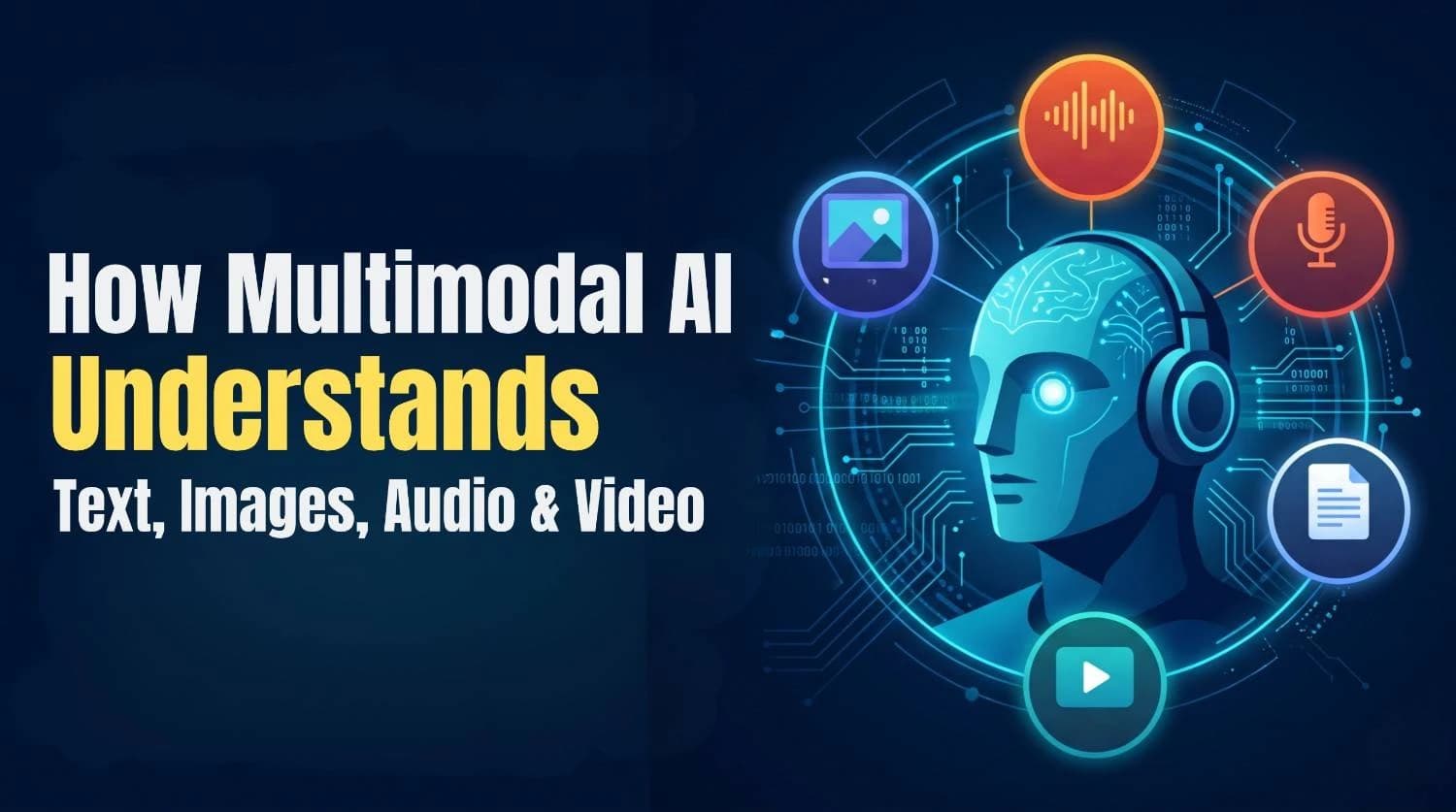
Artificial intelligence is moving beyond systems that understand only written instructions. Modern AI models can now analyse photographs, interpret spoken conversations, process video recordings, and connect information from multiple sources to generate meaningful responses. This capability is known as Multimodal AI.
Consider a practical situation: a developer uploads a screenshot of a website error, shares a screen recording showing the problem, and explains the issue through a voice message. A traditional text-based chatbot may only understand the written description. A multimodal AI system can analyse the screenshot, interpret the spoken explanation, and examine the video to understand what is happening.
This represents a significant development in artificial intelligence. By combining different types of information, multimodal systems can understand complex situations more effectively and support applications across education, healthcare, software development, and business automation.
Understanding how multimodal AI works also helps developers and businesses identify opportunities to build more intelligent applications.
Multimodal AI refers to artificial intelligence systems designed to process and understand multiple types of data, including text, images, audio, and video.
The word modality describes a particular form of information. Traditional AI applications often specialise in one modality. For example, natural language processing handles text, while computer vision focuses on visual information.
Multimodal systems connect these capabilities within a unified architecture.
The four major modalities include:
Text: Written instructions, documents, questions, and conversations.
Images: Photographs, screenshots, charts, diagrams, and scanned documents.
Audio: Spoken language, music, voice recordings, and environmental sounds.
Video: Moving images, actions, scene changes, and accompanying audio.
The main objective is not simply to process these formats independently. It is to understand the relationships between them.
Multimodal AI uses specialised neural network components to transform different types of information into representations that a model can interpret.
1. Data Collection and Preprocessing
The process begins when users provide information through different formats.
Before processing, each input is prepared according to its structure.
Text is divided into smaller units called tokens. Images may be resized or divided into visual patches. Audio signals are converted into digital representations, while videos can be separated into selected frames and audio segments.
This preprocessing ensures that different inputs can be handled by the model's architecture.
2. Modality-Specific Encoders
An encoder converts raw information into numerical representations that capture useful features.
Different modalities require different processing techniques.
Text encoders identify words, language patterns, and contextual relationships.
Vision encoders extract objects, shapes, colours, and spatial information.
Audio encoders identify speech patterns, acoustic features, and sounds.
Video-processing components analyse visual frames and changes over time.
These components help the model recognise meaningful information from different sources.
3. Multimodal Fusion and Alignment
After extracting features, the system connects information from different modalities.
This process is commonly called multimodal fusion. Techniques such as cross-attention and contrastive learning help models identify relationships between different data representations.
For example, when a model receives an image of a dog and the sentence "A dog is running in a park," it can learn to associate the visual content with the corresponding language.
This relationship allows AI systems to answer questions about images, connect spoken instructions with visual information, and interpret content across multiple formats.
4. Reasoning and Response Generation
Once the information is processed and aligned, the model uses its learned representations to generate a response.
Depending on the architecture, it may produce text, spoken responses, image descriptions, or other outputs.
For example, a user can upload a chart and ask, "Which month recorded the highest sales?" The system analyses the visual information, interprets the question, and generates a relevant answer.
Understanding Text
Text understanding relies heavily on natural language processing and transformer-based architectures.
The model converts words into tokens and numerical representations. Attention mechanisms help identify relationships between words and understand how context influences meaning.
This enables multimodal AI to interpret questions, summarise documents, follow instructions, and connect written language with other forms of information.
Understanding Images
Image understanding is supported by computer vision techniques and architectures such as Vision Transformers (ViTs).
These models can divide an image into smaller patches and convert them into numerical representations.
By analysing visual patterns, the model can identify objects, recognise text, understand diagrams, and examine relationships between elements.
Common applications include screenshot analysis, document understanding, image captioning, and visual question answering.
Understanding Audio
Audio understanding involves processing sound signals to recognise speech, language, and acoustic information.
Depending on the architecture, audio can be represented using spectrograms, learned audio features, or discrete audio tokens.
Modern multimodal systems can support speech recognition, voice-based conversations, translation, and audio classification.
For example, an AI assistant can listen to a meeting recording, identify important discussion points, and produce a structured summary.
Understanding Video
Video introduces an additional challenge because it contains visual information that changes over time.
Multimodal AI systems can extract video frames, analyse individual scenes, and connect visual information with accompanying audio.
Temporal understanding helps models identify actions, scene transitions, and relationships between events.
For example, an AI system can analyse an educational video and generate a summary of its main concepts. It can also answer questions about specific events within the recording.
Multimodal AI is becoming useful across several industries.
1. Healthcare: AI systems can help medical professionals analyse medical images alongside relevant clinical information. Human expertise remains essential for diagnosis and treatment decisions.
2. Education: Students can upload textbook images, ask questions through voice, and receive explanations combining visual and textual information.
3. Software Development: Developers can share code, screenshots, and screen recordings to investigate errors and understand interface problems.
4. Customer Support: Businesses can analyse customer messages, screenshots, and voice recordings to understand complaints and improve support workflows.
5. Business Automation: Organisations can process documents, meeting recordings, images, and other information to support reporting and operational tasks.
Multimodal AI offers several advantages over systems that work with only one data format.
Improved contextual understanding: Combines different sources of information for a broader interpretation.
Natural communication: Allows users to interact through speech, text, images, and video.
Better accessibility: Supports alternative ways of accessing and communicating information.
Workflow automation: Helps businesses analyse different types of content within connected processes.
Advanced content analysis: Supports image recognition, video summarisation, audio transcription, and visual question answering.
Despite its capabilities, multimodal AI still faces important challenges.
High computational costs: Processing high-resolution images, long videos, and continuous audio streams requires significant computing resources.
Accuracy problems: Models may misinterpret visual details, misunderstand speech, or generate incorrect explanations.
Data alignment: Connecting audio, video, and text accurately can become difficult when timestamps or contextual information do not match.
Privacy and security: Uploaded recordings, photographs, and documents may contain confidential information.
Bias and reliability: Limitations in training data can affect how models interpret different languages, environments, and visual situations.
Businesses should evaluate model performance, protect sensitive information, and introduce human verification for important decisions.
Provide clear instructions explaining how uploaded files relate to your question.
Use high-quality images and recordings for better input clarity.
Include timestamps when asking questions about specific video events.
Verify important information instead of accepting every generated response.
Choose models based on supported modalities, accuracy, latency, and processing costs.
Assuming every AI model supports every modality: Check the model's actual input and output capabilities.
Uploading poor-quality media: Blurry images and unclear audio can affect interpretation.
Ignoring video context: Individual frames may not capture the complete sequence of events.
Trusting every AI response: Multimodal systems can still hallucinate or misunderstand information.
Overlooking data privacy: Avoid uploading confidential material without appropriate permissions and security controls.
1. What is multimodal AI in simple terms?
Multimodal AI is artificial intelligence that can understand and process different types of information, including text, images, audio, and video, within one connected system.
2. How does multimodal AI process images and text together?
It converts visual and textual information into numerical representations and learns relationships between them. This allows the model to answer written questions about uploaded images.
3. What is the difference between multimodal AI and traditional AI?
Traditional AI systems often specialise in individual data types or tasks, whereas multimodal AI can connect multiple data formats to understand more complex information.
4. Which AI models support multimodal capabilities?
Several AI model families support multimodal capabilities, including OpenAI's GPT models, Google's Gemini, and Meta's multimodal models. Features vary depending on the specific model and version.
5. Where is multimodal AI used in real life?
It is used in healthcare support, education, customer service, software development, accessibility tools, video analysis, and intelligent virtual assistants.
Multimodal AI is expanding artificial intelligence beyond traditional text-based interactions. By connecting information from text, images, audio, and video, these systems can interpret more complex inputs and support a wider range of real-world applications.
Technologies such as specialised encoders, cross-attention, neural networks, and multimodal fusion make it possible to connect different forms of information within a unified system.
For developers, businesses, and technology professionals, understanding multimodal AI creates opportunities to build more capable applications, automate complex workflows, and improve human-computer interaction.
As AI architectures continue to evolve, multimodal intelligence will play an increasingly important role in the next generation of digital products and services.
Written by
Alaffiya Madarwala
Last updated
19 November 2026
