HTML vs HTML5: What's the Difference? Complete Beginner's Guide (2026)
HTML vs HTML5: What's the Difference?
If you're starting your journey in web development, you've probably come across the terms HTML and HTML5. While they may sound similar, HTML5 is a major upgrade that introduced modern features for building faster, more interactive, and multimedia-rich websites.
Understanding the difference between HTML and HTML5 is essential for beginners because almost every modern website today is built using HTML5. In this guide, we'll explain the key differences, features, and benefits of HTML5 in a simple and beginner-friendly way.
What is HTML?
HTML (HyperText Markup Language) is the standard markup language used to create the structure of web pages. It defines elements such as headings, paragraphs, images, links, and tables that browsers display on the screen.
Earlier versions of HTML provided the basic structure of websites but relied heavily on external plugins and additional technologies for multimedia and advanced functionality.
What is HTML5?
HTML5 is the latest version of HTML that was introduced to make web development simpler, faster, and more powerful. It supports modern web applications, multimedia, graphics, and responsive design without requiring third-party plugins like Adobe Flash.
Today, HTML5 is the industry standard and is supported by all major web browsers.
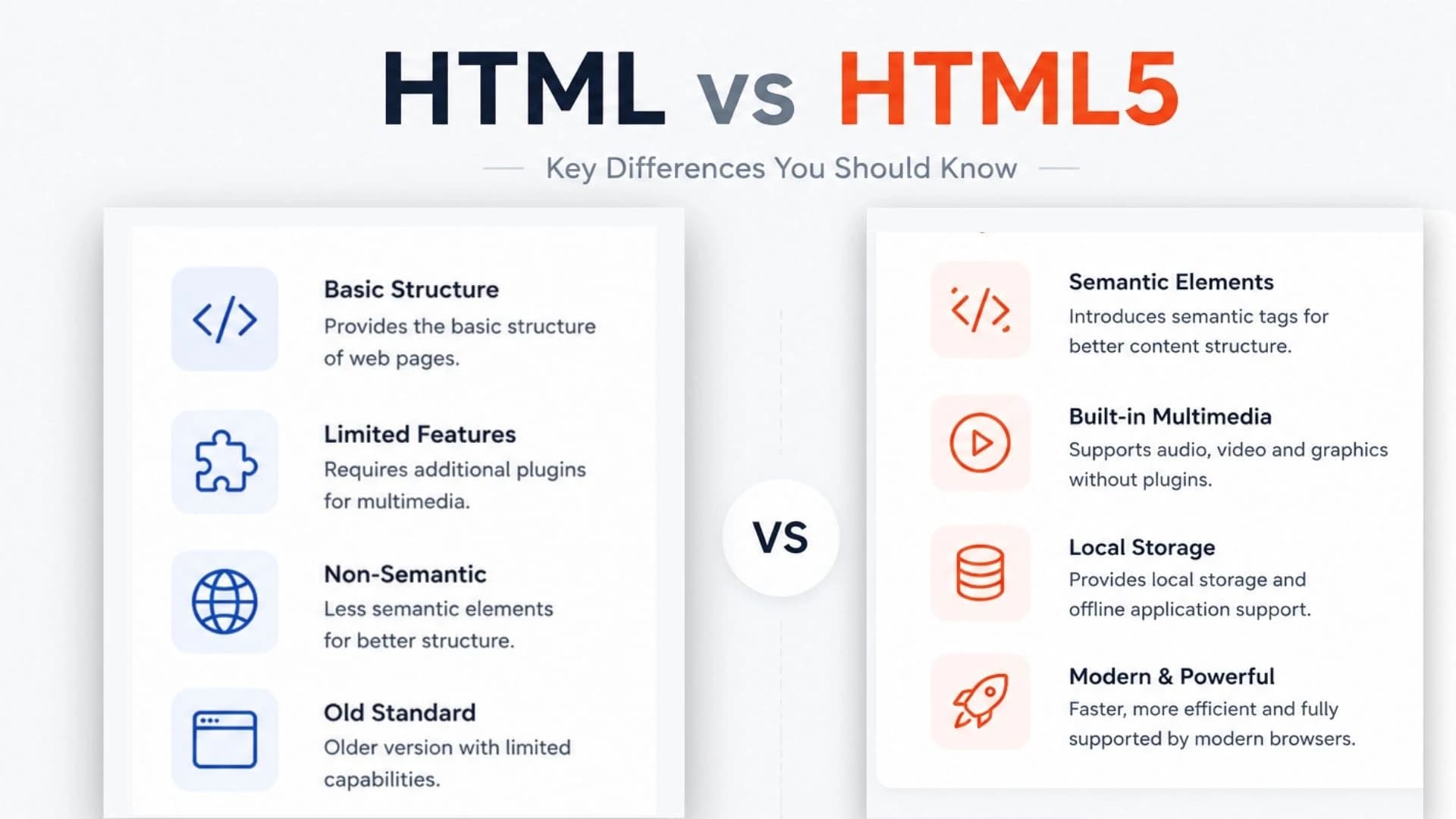
HTML vs HTML5: Key Differences
Feature | HTML | HTML5 |
|---|---|---|
Multimedia Support | Requires plugins | Built-in audio and video support |
Semantic Elements | Limited | Includes semantic tags like |
Graphics | Limited | Supports Canvas and SVG |
Local Storage | Not Available | Built-in Local Storage and Session Storage |
Performance | Basic | Faster and optimized for modern web applications |
Why HTML5 is Better
HTML5 introduced several features that make websites more efficient and user-friendly. Semantic elements improve SEO by helping search engines understand the structure of a webpage. Built-in multimedia support allows developers to embed videos and audio directly without external plugins.
It also provides APIs such as Geolocation, Drag and Drop, Offline Storage, and Web Workers, making modern web applications faster and more interactive.
Advantages of HTML5
Better SEO with semantic elements
Native audio and video support
Faster website performance
Improved mobile compatibility
Cross-browser support
Enhanced security
Better user experience
Should Beginners Learn HTML or HTML5?
If you're learning web development today, you should start directly with HTML5. It includes all the core concepts of HTML while providing the modern features required to build professional websites. Learning HTML5 will prepare you for CSS, JavaScript, React, Next.js, and other modern web technologies.
Frequently Asked Questions
Is HTML5 different from HTML?
Yes. HTML5 is the latest version of HTML and includes new features such as semantic elements, multimedia support, graphics, and modern APIs.
Is HTML5 replacing HTML?
HTML5 is the current standard version of HTML. When developers say "HTML" today, they usually mean HTML5.
Is HTML5 good for SEO?
Yes. Semantic tags like <header>, <main>, <article>, and <footer> help search engines better understand your website, improving SEO.
Should I learn HTML5 before CSS and JavaScript?
Absolutely. HTML5 is the foundation of web development, and learning it first makes CSS and JavaScript much easier to understand.
Conclusion
HTML5 has transformed web development by introducing powerful features that improve website performance, SEO, and user experience. From semantic elements and multimedia support to offline storage and responsive design, HTML5 provides everything developers need to build modern websites. If you're beginning your web development journey in 2026, learning HTML5 is one of the best investments you can make.
Written by
Praxiaskill
Last updated
28 July 2026