
MLOps: Data Drift and Model Retraining in Production
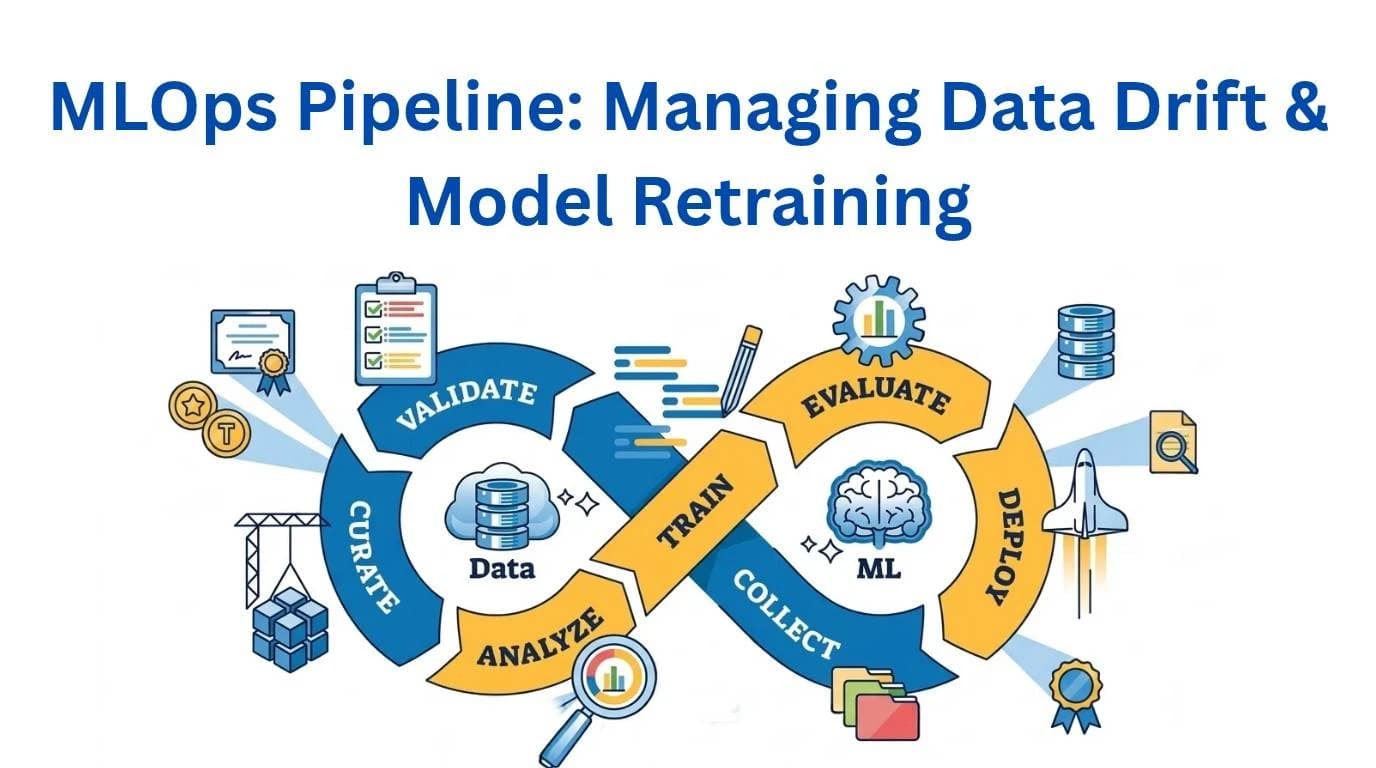
A machine learning model does not stop evolving when it reaches production. Customer behaviour changes, market conditions shift, new data patterns emerge, and business requirements develop. A model that performs accurately during testing can gradually become unreliable when real-world conditions no longer match its training environment.
This is why organisations need an end-to-end MLOps pipeline that connects data ingestion, model development, deployment, monitoring, drift detection, and retraining.
MLOps (Machine Learning Operations) combines machine learning, data engineering, and DevOps practices to make ML systems reproducible, scalable, and reliable. Its purpose is not simply to automate model deployment, but to manage the model throughout its production lifecycle.
Training a machine learning model using historical data is only the beginning. Once deployed, the model receives new inputs that may differ significantly from the examples it learned during development.
For example, an e-commerce recommendation model trained on previous shopping behaviour may become less effective when customer preferences change, new product categories emerge, or seasonal purchasing patterns develop.
Without monitoring, the model may continue producing predictions even when its accuracy has deteriorated.
An effective MLOps pipeline addresses this challenge by continuously collecting production data, monitoring model behaviour, detecting distribution changes, and initiating retraining when predefined conditions are met.
The objective is to maintain model reliability without retraining unnecessarily or allowing an untested model to enter production.
An end-to-end MLOps pipeline automates and manages the complete machine learning lifecycle, from raw data collection to production monitoring and model updates.
A typical workflow includes:
Data ingestion and storage
Data validation and preprocessing
Feature engineering
Model training and experiment tracking
Model evaluation and registration
Automated deployment
Production monitoring
Drift detection and model retraining
Each stage should produce versioned outputs and metadata so that teams can reproduce experiments, investigate failures, and understand which data and code produced a particular model version.
Core Components of an MLOps Architecture
Component | Primary responsibility |
Data pipeline | Collects and processes incoming data |
Feature pipeline | Creates consistent model features |
Experiment tracker | Records parameters and training results |
Model registry | Stores and versions approved models |
CI/CD pipeline | Tests and deploys model updates |
Monitoring system | Tracks data quality and model performance |
Orchestrator | Coordinates automated pipeline execution |
A model registry and experiment-tracking system are particularly important because production teams need to know which model is deployed, how it was trained, and whether a replacement has passed validation.
Data drift occurs when the statistical distribution of incoming production data changes compared with the data used during training.
However, not every distribution change means that model accuracy has declined. Understanding different types of drift helps teams select appropriate monitoring strategies.
Data Drift
Data drift occurs when input feature distributions change over time.
For example, a loan approval model may have been trained using applicants whose average income was ₹50,000 per month. If the incoming applicant population changes significantly, the model may receive inputs that are less representative of its training data.
Concept Drift
Concept drift occurs when the relationship between input features and the target variable changes.
For example, a fraud detection model may learn that certain transaction patterns are associated with fraudulent activity. If fraudsters change their techniques, those previously reliable patterns may no longer predict fraud accurately.
Prediction Drift
Prediction drift occurs when the distribution of model outputs changes.
A classification model that previously predicted 10% of transactions as high risk might suddenly predict 35%. This change could indicate a shift in incoming data, a model issue, or a genuine change in the underlying environment.
Drift type | What changes? | Example |
Data drift | Input distribution | Customer age distribution changes |
Concept drift | Feature-target relationship | Fraud patterns evolve |
Prediction drift | Output distribution | More transactions classified as high risk |
These signals should be investigated together rather than treated as interchangeable evidence of model failure.
The first operational stage is collecting reliable data from production systems.
Sources may include databases, APIs, application logs, IoT devices, customer transactions, and streaming platforms.
Tools such as Apache Kafka, Apache Airflow, and cloud data services can support ingestion and orchestration.
After collection, the pipeline should validate incoming data before it reaches model training or inference.
Important checks include:
Schema validation to identify unexpected columns or data types.
Missing-value checks to detect incomplete records.
Range validation to identify impossible or unusual values.
Duplicate detection to prevent repeated records.
Data freshness checks to identify delayed updates.
Feature consistency checks to prevent training-serving skew.
For example, if a model expects transaction amounts in Indian rupees but an upstream system starts sending values in another currency, the pipeline should detect the change rather than silently passing incorrect data to the model.
Data validation protects both training and production inference. Retraining on poor-quality data can make an existing model worse instead of improving it.
Once the model is deployed, the monitoring system should compare incoming production data with an appropriate reference dataset.
Common statistical techniques include:
Population Stability Index (PSI): Measures changes between two distributions, often using predefined feature bins.
Kolmogorov-Smirnov (KS) test: Compares distributions of continuous numerical variables.
Chi-square test: Helps identify distribution changes in categorical variables.
Jensen-Shannon divergence: Measures the difference between probability distributions.
For example, a team monitoring a customer churn model might track customer age, monthly spending, subscription duration, and usage frequency.
If the distribution of monthly spending changes substantially, the monitoring system can generate an alert for investigation.
The monitoring process should also track prediction distributions, feature-level changes, missing values, and model performance when ground-truth labels become available.
Important: Statistical thresholds should be selected for the model and business context. A drift score is an alert signal, not automatic proof that accuracy has declined. Microsoft recommends combining data-quality, drift, and performance signals, with monitoring frequency based on production data volume.
Model retraining updates an existing model using newer, relevant training data.
A continuous training pipeline can initiate a new training run when predefined conditions are met.
Common retraining triggers include:
Scheduled triggers: Daily, weekly, or monthly training cycles.
Drift-based triggers: Significant changes in monitored input distributions.
Performance triggers: Accuracy, F1-score, precision, recall, or error metrics falling below acceptable limits.
Data-volume triggers: A sufficient amount of newly labelled data becomes available.
Manual triggers: A data scientist initiates retraining after identifying a problem.
A practical production system often combines scheduled retraining with event-based triggers.
For instance, an e-commerce recommendation model could undergo monthly retraining while also initiating an investigation when customer behaviour changes sharply.
However, retraining should not automatically mean deployment. A new model must pass evaluation before replacing the existing production version.
After retraining, the candidate model must be evaluated against the current production model.
The existing production model is often called the champion, while the newly trained candidate is the challenger.
Both models should be tested using the same appropriate validation dataset and evaluation criteria.
For a classification model, teams may compare:
Accuracy
Precision and recall
F1-score
ROC-AUC
Confusion matrix
Performance across important customer segments
For regression models, relevant metrics may include MAE, MSE, and RMSE.
Evaluation should also consider business constraints. A fraud detection model, for example, should not be approved simply because its overall accuracy improves if it misses more high-value fraudulent transactions.
Once the challenger passes the required checks, it can be registered and moved through staging to production.
Safer Model Deployment Strategies
Canary deployment: Release the candidate to a small portion of production traffic before increasing exposure.
Shadow deployment: Run the candidate alongside the existing model without allowing it to control actual decisions.
Blue-green deployment: Maintain two deployment environments and switch traffic after validating the replacement.
Rollback: Restore the previous approved model if production metrics deteriorate.
These techniques reduce the risk of introducing an unstable model into a live application.
The right technology stack depends on infrastructure, model complexity, team expertise, and operational requirements.
Tool | MLOps application |
MLflow | Experiment tracking and model registry |
Kubeflow | Kubernetes-based ML pipelines |
Apache Airflow | Workflow orchestration |
Evidently AI | Data and model monitoring |
Feast | Feature store management |
Amazon SageMaker | Managed training, monitoring, and deployment |
Azure Machine Learning | Model lifecycle management and monitoring |
For example, a team could use Airflow to schedule data pipelines, MLflow to track experiments and model versions, Evidently to monitor drift, and Kubernetes to deploy model-serving services.
These tools can be integrated into a unified workflow rather than treated as separate systems.
Version everything: Maintain versions of datasets, code, features, configurations, and model artifacts.
Monitor business outcomes: Technical metrics alone may not reveal whether the model is delivering business value.
Prevent training-serving skew: Reuse consistent feature definitions and transformations wherever possible.
Avoid unnecessary retraining: A change in input distribution should trigger investigation, not automatic promotion of a new model.
Maintain audit trails: Record training runs, evaluation results, approval decisions, and deployment history.
Retraining without validation: A newly trained model is not necessarily better.
Ignoring data quality: Incorrect or incomplete data can undermine every subsequent training run.
Monitoring only accuracy: Data drift, latency, prediction changes, and business metrics also matter.
Using fixed thresholds everywhere: Drift thresholds should reflect feature behaviour and business risk.
Ignoring delayed labels: Some applications need time before actual outcomes become available.
1. What is an end-to-end MLOps pipeline?
An end-to-end MLOps pipeline manages the complete machine learning lifecycle, including data ingestion, preprocessing, training, evaluation, deployment, monitoring, and retraining.
2. What is data drift in machine learning?
Data drift occurs when the distribution of production input data changes compared with the reference data used during model training.
3. How often should a production ML model be retrained?
There is no universal retraining schedule. Frequency depends on data changes, model performance, business requirements, and the availability of new labelled data.
4. Does data drift always mean that a model needs retraining?
No. Drift indicates that incoming data has changed, but it does not necessarily mean prediction quality has declined. Teams should investigate performance and business impact before approving retraining.
5. Which tools are commonly used for MLOps?
MLflow, Kubeflow, Apache Airflow, Evidently AI, Feast, Amazon SageMaker, and Azure Machine Learning are commonly used to manage different stages of production ML workflows.
An effective MLOps pipeline extends beyond training and deploying a machine learning model. It creates a continuous process for validating data, monitoring production behaviour, identifying drift, and evaluating new model versions.
The most reliable approach combines automated monitoring and retraining with strict validation, model versioning, controlled deployment, and rollback capabilities.
For ML engineers and data science teams, the goal is not to retrain models as frequently as possible. It is to recognise when production conditions have changed, determine whether the model needs improvement, and deploy a replacement only when the evidence supports it.
That is what turns a machine learning experiment into a dependable production system.
Written by
Alaffiya Madarwala
Last updated
10 November 2026
