
Ransomware Attacks 2026: How to Protect Your Business
A ransomware attack can disrupt an entire business within hours. Employees may lose access to essential files, customer services can become unavailable, and sensitive information may be exposed. Even organizations with established IT systems are vulnerable when attackers find weaknesses in their networks, software or employee accounts.
Ransomware has also evolved beyond simply encrypting files. Many attackers now combine data theft with encryption, threatening to publish confidential information unless the victim pays. This makes ransomware protection a business continuity and data security priority, not just an IT responsibility.
For 2026, businesses need a layered security strategy that addresses prevention, early detection and reliable recovery. Here are the practices organizations should prioritize.
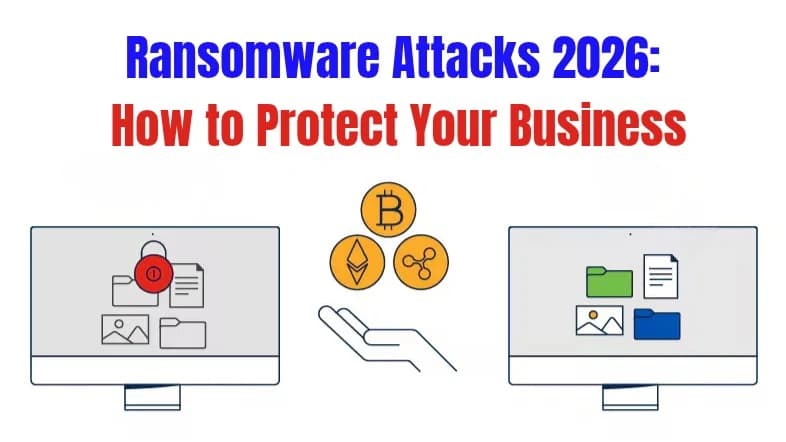
Ransomware is a type of malicious software that prevents users from accessing their systems or data, usually by encrypting files. Attackers then demand payment, often in cryptocurrency, in exchange for a supposed decryption key.
An attack can begin through a phishing email, compromised remote access account, malicious attachment, exposed internet-facing application or an unpatched software vulnerability.
Once inside a network, attackers may attempt to obtain administrative privileges, move between connected systems, locate valuable information and disable security or backup mechanisms.
Modern ransomware incidents can involve two separate threats:
Data encryption: Attackers make business files and systems inaccessible.
Data exfiltration: Attackers steal confidential information and threaten to publish or sell it.
This approach creates additional pressure because restoring encrypted files does not necessarily prevent stolen information from being disclosed.
The August 2026 joint CISA and FBI advisory on Gunra ransomware documents this double-extortion approach, demonstrating why businesses must protect both data availability and confidentiality.
Compromised credentials are a significant security concern for organizations. A stolen password can give attackers access to email accounts, remote access services, cloud applications and administrative systems.
Multi-factor authentication (MFA) adds another verification requirement beyond a password. Even if an attacker obtains login credentials, an additional authentication factor can make unauthorized access more difficult.
Businesses should prioritize MFA for:
Email and cloud administration accounts.
VPN and remote desktop access.
Privileged administrator accounts.
Backup management platforms.
Financial and business-critical applications.
Where supported, phishing-resistant authentication methods such as passkeys and hardware security keys provide stronger protection against credential theft.
Backups are among the most important defenses against ransomware-related data loss. However, simply creating backup copies is not enough.
Attackers may deliberately search for connected backup storage and attempt to delete or encrypt recovery files before launching the main ransomware operation.
Follow a backup strategy that includes multiple protected copies, including at least one offline or logically isolated copy.
Businesses should also consider immutable backups, which prevent stored data from being modified or deleted during a defined retention period.
More importantly, regularly test the restoration process. A backup that cannot restore essential applications, databases and business records within an acceptable timeframe is not a dependable recovery solution.
NIST's June 2026 ransomware risk management publication, IR 8374 Rev. 1, provides an updated framework for managing these risks.
Outdated operating systems, applications, VPN software and network devices can expose businesses to known security weaknesses.
Attackers frequently look for systems that have not received important security updates. A single vulnerable internet-facing service can provide an entry point into a wider business network.
Organizations should maintain an inventory of hardware, software and internet-facing assets. Prioritize security updates based on vulnerability severity, exposure and evidence that attackers are actively exploiting a weakness.
CISA's Known Exploited Vulnerabilities (KEV) Catalog can help security teams identify vulnerabilities known to be exploited in real attacks.
Do not rely entirely on automatic updates. Critical systems should also undergo controlled patch testing to reduce compatibility and availability problems.
Antivirus software alone should not be treated as a complete ransomware defense.
Endpoint Detection and Response (EDR) solutions help security teams identify suspicious activity across computers and servers. They can provide visibility into unusual processes, unauthorized access and potentially malicious network connections.
Network segmentation provides another important layer of protection. Instead of allowing every device to communicate freely, divide the network into controlled sections.
For example, employee workstations should not have unrestricted access to financial databases, backup infrastructure or production servers.
If one workstation becomes infected, segmentation can make it more difficult for ransomware to spread throughout the organization.
Technology cannot eliminate every security risk created by human decisions.
An employee might open a malicious attachment, enter credentials on a fraudulent login page or approve an unexpected authentication request. Attackers often use convincing messages that imitate suppliers, colleagues and business partners.
Businesses should conduct regular cybersecurity awareness training that includes practical phishing simulations and examples of suspicious messages.
Employees should know how to:
Verify unexpected payment and password-reset requests.
Avoid opening suspicious attachments.
Report unusual login notifications.
Use approved methods to share sensitive information.
Contact IT teams when a device behaves unexpectedly.
A clear reporting process helps security teams investigate suspicious activity before it becomes a larger incident.
Even strong preventive controls cannot guarantee that a business will never experience ransomware.
An incident response plan establishes who makes decisions, how affected systems are isolated, where backup information is located and how employees and customers are informed.
The plan should identify critical business services, emergency contacts, external cybersecurity specialists and applicable regulatory reporting requirements.
Businesses should also conduct tabletop exercises to simulate realistic situations, such as an infected employee laptop or an unavailable customer database.
These exercises reveal practical weaknesses that security software alone cannot identify.
A fast and coordinated response can help limit the damage.
First, isolate affected systems. Disconnect infected devices from wired and wireless networks to reduce the possibility of further spread. If multiple systems are affected, qualified network administrators may need to isolate entire network segments.
Second, activate the incident response team. Contact internal security professionals and qualified external incident responders. Preserve relevant logs, ransom notes and other evidence.
Third, protect backup infrastructure. Secure unaffected backup systems and prevent unauthorized access or deletion.
Fourth, investigate the incident. Determine how attackers gained access, which systems were affected and whether confidential information was stolen.
Finally, restore operations carefully. Rebuild compromised systems, remove the original entry point, reset affected credentials and restore verified clean backups.
CISA and the FBI discourage ransom payments because payment does not guarantee data recovery and can encourage further criminal activity. Payment decisions require careful legal, regulatory, operational and law-enforcement consideration.
Use separate administrative accounts for privileged activities.
Apply least-privilege access across employees and third-party vendors.
Monitor unusual login activity and unexpected file modifications.
Encrypt sensitive information and protect encryption keys.
Restrict remote access to approved users and devices.
Review backup access permissions regularly.
Test full recovery procedures, not just individual file restoration.
Relying only on antivirus: Endpoint protection needs to work alongside access controls, monitoring and network security.
Keeping all backups connected: Permanently accessible backups may be vulnerable to the same attack.
Ignoring third-party access: Compromised vendor accounts can create pathways into business networks.
Delaying security updates: Known vulnerabilities can remain exploitable when patch management is neglected.
Failing to test recovery: Having backups does not prove that the organization can restore its operations successfully.
1. How can businesses prevent ransomware attacks in 2026?
Businesses should implement MFA, maintain updated software, use endpoint protection, restrict administrative access, segment networks, train employees and maintain tested offline or immutable backups.
2. Can ransomware infect cloud storage?
Yes. If attackers compromise cloud accounts or connected devices, they may encrypt, delete or steal accessible cloud data. Strong authentication, restricted permissions, versioning and protected backups help reduce this risk.
3. Should businesses pay ransomware attackers?
Payment is generally discouraged by cybersecurity authorities because it does not guarantee file recovery or prevent stolen information from being published. Organizations should consult qualified incident responders, legal advisers and relevant authorities before making decisions.
4. How long does ransomware recovery take?
Recovery time depends on the extent of the compromise, the availability of clean backups, system complexity and the organization's response capabilities. Tested recovery procedures and clearly defined restoration priorities can reduce disruption.
5. What is the most important ransomware protection measure?
There is no single control that prevents every ransomware attack. A combination of strong identity security, timely patching, network segmentation, endpoint monitoring and tested protected backups provides a more resilient defense.
Ransomware attacks can affect business operations, customer trust, financial stability and sensitive information. Preventing every possible attack is unrealistic, but organizations can significantly improve their security posture by reducing vulnerabilities and preparing for recovery.
The most effective ransomware strategy combines strong access controls, employee awareness, continuous monitoring, secure backups and a tested incident response plan.
Businesses should not wait for an attack to discover whether their security measures work. Building ransomware resilience today is essential to protecting tomorrow's operations.
Written by
Alaffiya Madarwala
Last updated
19 November 2026
