
Shadow AI: The Hidden Security Risk in Companies
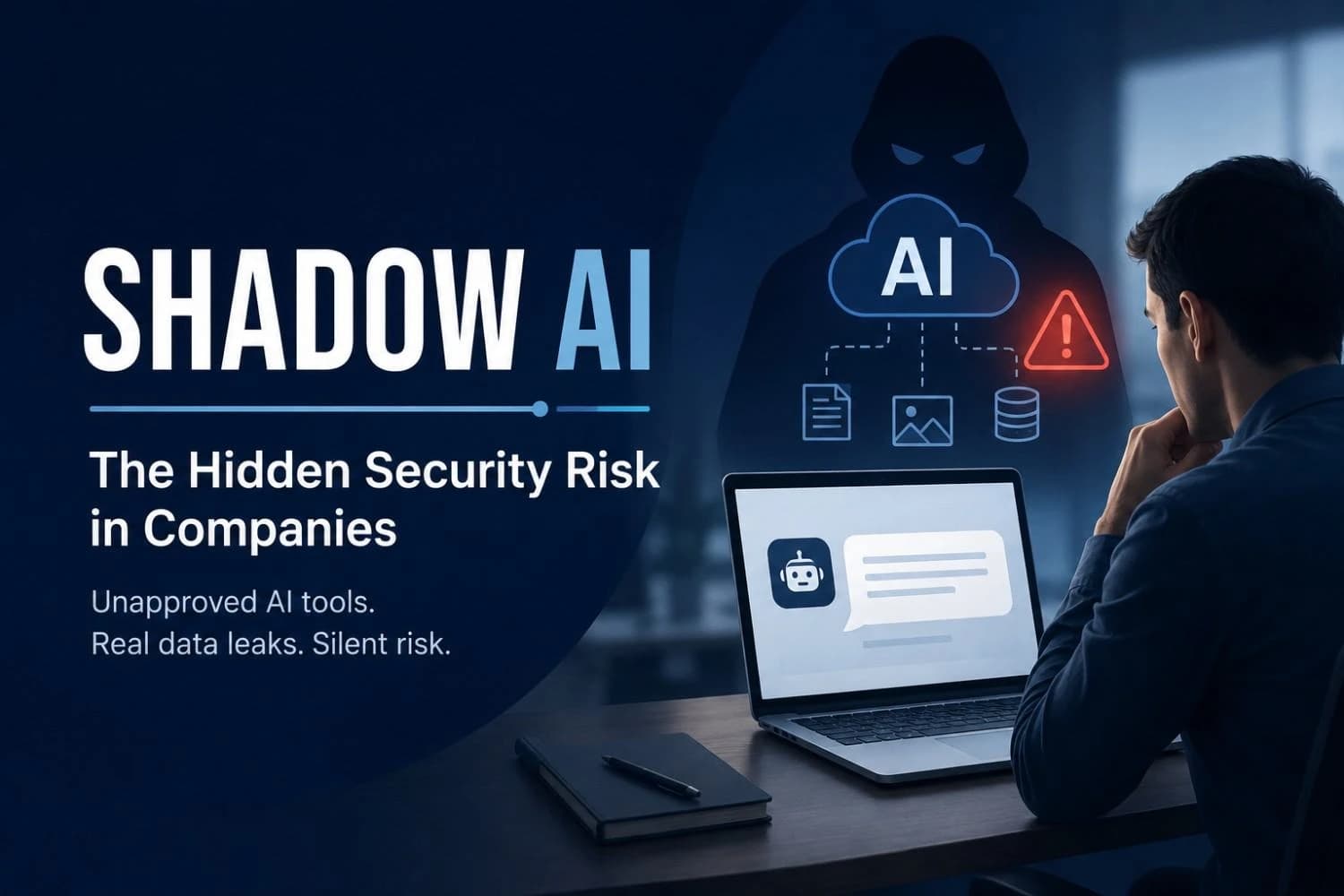
An employee has a presentation due in 20 minutes.
They open an AI chatbot, paste a few paragraphs from an internal report, ask it to improve the wording, and copy the result back into their presentation.
Nothing looks suspicious. No malware. No strange login. No obvious cyberattack.
But the employee may have just sent company information to an AI service that the security team never approved. That's the problem behind Shadow AI Explained: The Hidden Security Risk Inside Companies.
Shadow AI isn't necessarily about employees trying to break security rules. Often, they're simply trying to work faster. Recent reporting on Indian workplaces shows that AI adoption is moving faster than formal governance, with employees using personal AI accounts and unauthorized applications alongside approved enterprise tools.
The uncomfortable question for companies is therefore not “Are our employees using AI?”
It's “Do we know which AI tools they're using, what information they're sending, and what those tools can do?”
Shadow AI is the use of artificial intelligence applications without the knowledge, approval, or governance of an organization's IT or security teams.
It is closely related to shadow IT, but AI introduces an important difference: employees can send information directly into an AI system through a simple prompt, uploaded document, browser extension, coding assistant, or connected application.
IBM defines shadow AI as unsanctioned AI use and highlights data security, compliance, and reputational risks.
The risk also extends beyond obvious chatbots. AI features embedded inside productivity software, CRM platforms, coding tools, and autonomous agents can create additional data pathways.
That's why approving an application once isn't always enough.
AI tools are extremely easy to adopt.
An employee doesn't necessarily need a procurement process, installation request, or technical deployment. They can open a website, create an account, and start working within minutes.
That convenience creates a security gap.
Research published in August 2026 also suggests that perceived efficiency can encourage employees to use AI and share more information, while training and policy awareness can reduce risky disclosure.
For companies, this creates a difficult balance:
Block everything → employees may find workarounds.
Allow everything → sensitive information may leave controlled systems.
The better approach is controlled, visible, and practical AI adoption.
1. Employees Can Accidentally Leak Sensitive Data
An employee might paste customer information, financial figures, internal documents, or source code into an AI tool simply because they want help analyzing it.
The problem isn't always malicious intent. It's often a lack of awareness. Once information has been submitted to an external service, the company may have limited control over how that information is stored or processed.
2. Intellectual Property Can Leave the Organization
Source code, product plans, marketing strategies, research, and proprietary processes can represent years of work. Uploading even a small portion to an unauthorized AI service can create an intellectual-property risk.
IBM has documented cases and research around employees entering corporate information into public AI services, highlighting the potential exposure of proprietary code and sensitive business information.
For technology companies, this is especially serious.
3. Personal AI Accounts Create Visibility Gaps
An employee may use a personal AI account even when the company provides an approved enterprise tool. From the employee's perspective, the difference may seem insignificant.
From a security perspective, it can be enormous. The organization may lose visibility into account ownership, retention settings, administrative controls, and data handling.
4. AI-Enabled SaaS Features Can Create Hidden Data Paths
Shadow AI isn't limited to websites employees visit intentionally. AI functionality is increasingly built into software employees already use.
A CRM, document platform, coding environment, or productivity application may introduce AI capabilities that weren't included in the original security assessment.
Microsoft's recent guidance emphasizes discovering AI applications and understanding the associated data, compliance, and security risks.
5. Unauthorized Integrations Expand the Attack Surface
AI tools can connect to files, APIs, applications, and external services. That means the risk isn't necessarily the chatbot itself.
The bigger concern can be what the AI is connected to. An unmanaged AI agent with access to internal systems deserves much more scrutiny than a simple writing assistant.
6. Compliance Requirements Can Be Bypassed
Companies may have strict rules governing customer information, financial records, employee data, or other sensitive information. An employee using an unapproved AI tool can unintentionally bypass those controls.
Depending on the organization and jurisdiction, this can create regulatory, contractual, or privacy problems. Microsoft specifically identifies data leakage, noncompliance, and reputational harm among the risks of unmanaged AI use.
7. Security Teams May Not Know What Exists
Traditional security programs depend heavily on asset visibility. Shadow AI breaks that assumption. If security teams don't know which tools employees are using, they can't properly assess their risk.
Current Microsoft guidance includes network-based discovery of unsanctioned AI applications, illustrating how organizations can begin building visibility into AI usage.
8. AI Agents Create a Bigger Problem Than Chatbots
A chatbot generally responds to prompts.
An AI agent can potentially take actions.
That distinction matters.
Modern governance discussions increasingly focus on agents that can interact with systems, access information, or execute tasks. Google Cloud warns that shadow agents introduce additional concerns such as autonomous action and goal hijacking.
A company should therefore assess not only what AI knows, but also what AI can do.
9. Employees May Trust AI Too Much
AI-generated answers can sound convincing even when they're incorrect.
Imagine an employee using an unapproved AI tool to summarize a confidential report, analyze financial information, or generate technical recommendations.
The output may contain errors that nobody notices.
Shadow AI can therefore create both information-security risk and decision-making risk.
10. Banning AI Can Push Usage Further Underground
This is one of the most overlooked issues.
If employees find an AI tool genuinely useful but the company simply blocks it, some may look for alternatives.
Recent reporting from India indicates that more mature organizations are moving toward visibility, data classification, monitoring, and secure alternatives rather than relying solely on outright blocking.
Good security should make the safe option the convenient option.
Start With Visibility
Before creating a long policy document, find out what is already happening.
Companies should identify:
Which AI tools employees use.
Which departments use them.
What types of data are being entered.
Whether personal accounts are involved.
Which AI applications have integrations.
Which tools can take autonomous actions.
Discovery is the foundation of effective AI governance.
Create Simple Data Rules
Employees need practical guidance.
For example:
Public information: Generally suitable for approved AI tools.
Internal information: Use only approved company systems.
Confidential or regulated information: Follow specific security controls before processing.
A complicated 30-page policy may be less useful than a clear one-page decision guide.
Provide Secure Alternatives
If employees need AI for writing, coding, research, or analysis, give them approved tools that solve those problems.
Security teams should work with employees rather than treating productivity as the enemy. That approach can reduce the incentive to use unauthorized services.
Monitor and Review Continuously
AI changes quickly.
A tool that was low-risk six months ago may introduce new integrations, agents, or data-processing features today.
Google Cloud's 2026 AI risk research similarly emphasizes that organizations need visibility into AI implementation and governance rather than focusing only on the underlying models.
Expert Tips Section
Don't punish employees for using shadow AI. They're solving real problems. Listen and incorporate their needs into your governance strategy.
If you have a data breach from shadow AI, treat it like any other breach. Report it promptly and update your policies.
Assume AI agents have more access than you think. Audit permissions regularly.
Common Mistakes Section
Assuming shadow AI isn't happening. 90% of AI usage in enterprises is invisible.
Banning AI tools entirely. This drives usage underground and reduces visibility.
Treating AI agents like regular users. They move at machine speed and across multiple apps—they're different.
No visibility into embedded AI features. AI in approved SaaS apps is still shadow AI if IT doesn't control it.
Frequently Asked Questions
What is Shadow AI in cybersecurity?
Shadow AI is the unauthorized or ungoverned use of AI tools within an organization. It can expose companies to data leakage, compliance problems, intellectual-property loss, and unmanaged security risks.
Why is Shadow AI dangerous for companies?
The main concern is loss of visibility and control. Employees may submit sensitive information to external AI services or connect AI tools to company systems without security teams knowing.
Is Shadow AI the same as Shadow IT?
They are related, but not identical. Shadow IT covers unauthorized technology generally, while Shadow AI specifically involves AI applications, assistants, models, or agents. AI can create additional risks because it can process, summarize, generate, and sometimes act on organizational data.
How can companies detect Shadow AI?
Organizations can combine network and application discovery, identity information, SaaS inventories, endpoint controls, and data-loss prevention monitoring to identify unauthorized AI usage. Modern discovery tools can help security teams catalog AI services being accessed across the organization.
Should companies ban Shadow AI completely?
Usually, a blanket ban is difficult to enforce and may encourage employees to find less visible alternatives. A stronger approach is to discover usage, classify risks, establish clear policies, provide approved tools, and monitor high-risk activity.
Conclusion
Shadow AI Explained: The Hidden Security Risk Inside Companies ultimately comes down to one uncomfortable reality: employees can adopt powerful AI tools faster than organizations can govern them.
The biggest mistake is assuming that Shadow AI is simply an employee problem. It is often a visibility and workflow problem. If employees need AI to summarize documents, write code, analyze information, or complete routine tasks, companies should provide secure ways to do those things.
At the same time, security teams need visibility into AI applications, data flows, accounts, integrations, and agent permissions.
The future of enterprise AI security won't be built by pretending employees won't use AI. It will be built by making responsible AI use easier than risky AI use.
Written by
Praxiaskill
Last updated
3 September 2026
