
Small vs Large Language Models: Which Is Better?
Artificial intelligence is becoming an essential part of modern software development, business automation, and digital products. From customer support chatbots to advanced coding assistants, language models are powering applications that previously required extensive manual work.
However, not every AI application needs an extremely large model.
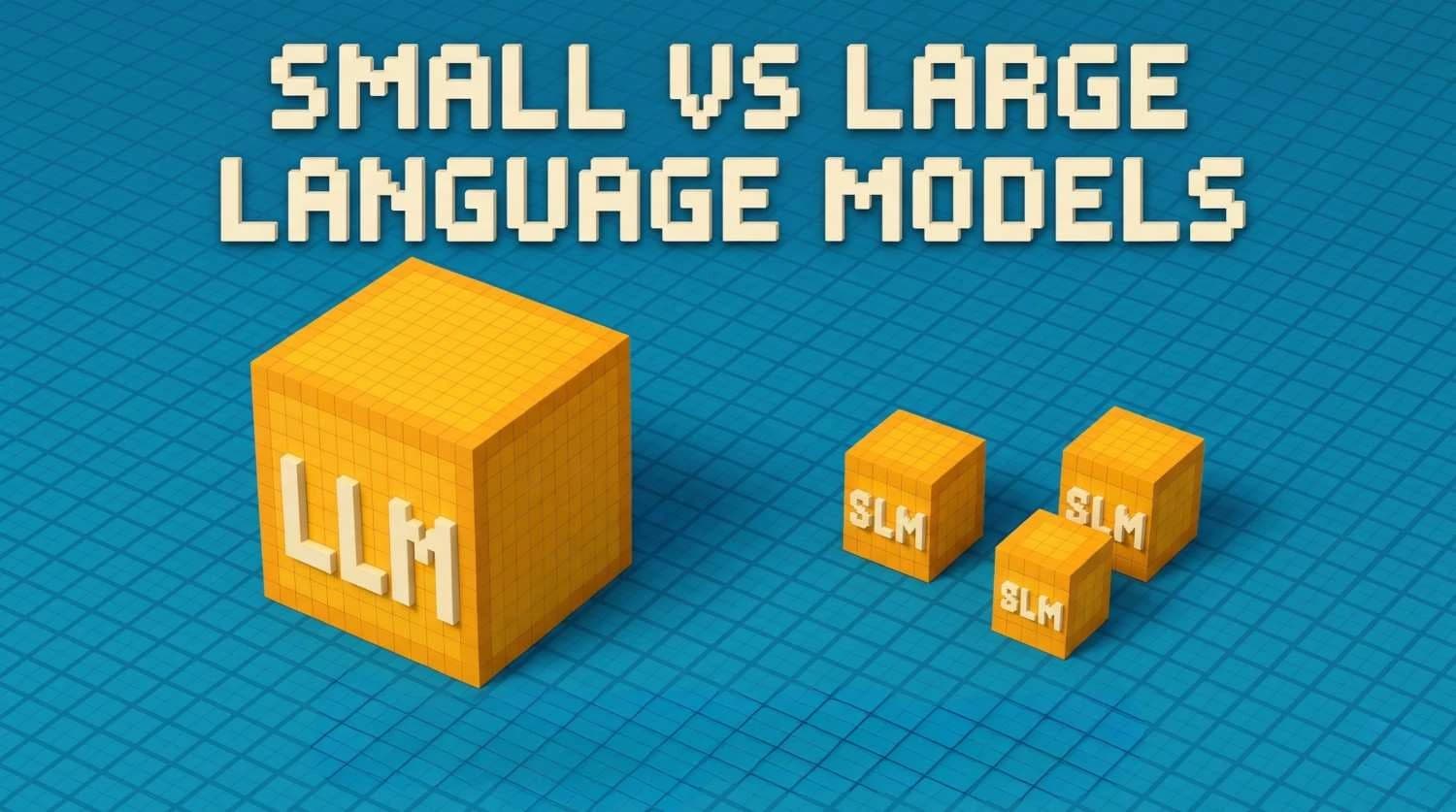
While Large Language Models (LLMs) attract attention because of their advanced reasoning and broad capabilities, Small Language Models (SLMs) are gaining popularity for their efficiency, affordability, and ability to run in resource-constrained environments.
This creates an important question for developers and businesses: Are larger AI models always better, or can smaller models deliver better results for specific applications?
Understanding the differences between SLMs and LLMs helps organisations select the right architecture without spending unnecessarily on computational resources.
Small Language Models are compact AI models designed to perform language-related tasks using fewer computational resources than large models.
They generally contain fewer parameters, require less memory, and can operate on local devices or relatively modest infrastructure.
Although smaller models may have narrower capabilities, they can perform remarkably well when trained or fine-tuned for specific tasks.
For example, a business that needs an automated customer support assistant may not require an advanced model capable of writing software, analysing scientific research, and generating complex reports. A specialised SLM may be sufficient to answer frequently asked questions and classify customer messages.
Popular examples include Microsoft's Phi family and Google's Gemma family.
Key characteristics of SLMs:
Lower memory and computational requirements.
Faster inference for many focused workloads.
Lower deployment and operating costs.
Potential for on-device and offline processing.
Easier customisation for specific business requirements.
Large Language Models are advanced AI systems trained on extensive datasets containing text, code, and other information.
They typically contain billions of parameters or more, enabling them to learn complex language patterns, relationships, and contextual information.
LLMs are designed to handle a broad range of tasks without requiring separate models for every application.
For example, a developer can use an LLM to explain programming concepts, generate code, troubleshoot errors, summarise technical documentation, and analyse complex requirements.
Examples include OpenAI's GPT models, Google's Gemini, Meta's Llama, and Anthropic's Claude.
Key characteristics of LLMs:
Broad knowledge across different subjects.
Strong capabilities for complex reasoning and content generation.
Support for diverse applications and workflows.
Ability to handle complex instructions and conversations.
Higher computational and infrastructure requirements.
The main difference between SLMs and LLMs is the balance between computational efficiency and general-purpose capabilities.
Comparison | Small Language Models | Large Language Models |
Model size | Relatively few parameters | Billions to trillions of parameters |
Processing | Often faster for focused tasks | Higher computational requirements |
Cost | Generally lower | Generally higher |
Memory | Requires less memory | Requires more memory |
Deployment | Mobile, local, edge, or cloud | Primarily powerful cloud or server infrastructure |
Customisation | Efficient for targeted fine-tuning | Supports advanced customisation |
Knowledge | Often narrower | Generally broader |
Reasoning | Suitable for defined tasks | Better suited to many complex tasks |
Privacy | Can run locally | Often uses external cloud services |
Scalability | Efficient for focused workloads | Suitable for diverse, complex workloads |
These are general tendencies rather than guarantees. Actual performance depends on model architecture, quantisation, training data, hardware, and the quality of the application.
SLMs are becoming attractive because businesses do not always need the capabilities of a large AI system.
1. Lower Operating Costs
Smaller models generally require fewer computing resources. This can reduce infrastructure expenses, especially when applications process thousands of repetitive requests.
2. Faster Response Times
With fewer parameters to process, SLMs can deliver low-latency responses on suitable hardware. This makes them useful for real-time applications.
3. On-Device Deployment
Some small models can run directly on smartphones, laptops, and edge devices. This reduces dependence on continuous internet connectivity.
4. Better Data Control
Local deployment can help organisations keep sensitive information within their own infrastructure, although appropriate security controls are still necessary.
5. Task-Specific Performance
Fine-tuning a smaller model with carefully selected domain-specific data can produce strong results for specialised tasks.
LLMs remain important because of their ability to handle diverse and complicated requirements.
1. Advanced Reasoning
Large models can handle complex instructions, multi-step problems, and tasks involving relationships between different subjects.
2. Broader Knowledge
Their extensive training allows them to work across programming, business, education, science, and other domains.
3. Versatile Content Generation
LLMs can generate articles, reports, technical documentation, marketing content, and software code.
4. Complex Problem-Solving
They are useful for analysing lengthy documents, comparing information, debugging code, and supporting research workflows.
5. Flexible Applications
A single LLM can power multiple features within an application, reducing the need to maintain several specialised models.
Choosing between SLMs and LLMs becomes easier when you consider the actual task.
Small Language Model applications:
Customer support FAQ automation.
Email classification and sentiment analysis.
Document categorisation and data extraction.
Text summarisation for short documents.
On-device writing assistance.
Basic conversational assistants.
Advanced AI coding assistants.
Complex research and document analysis.
Multi-step AI agents.
Detailed content generation.
Technical troubleshooting.
Complex business intelligence workflows.
For example, an e-commerce business could use an SLM to classify customer queries and identify order-related requests. An LLM could handle complicated customer complaints that require understanding several conversations and generating a detailed response.
The choice does not always have to be between a small and a large model.
A growing architectural approach is to combine both within one AI application.
In a hybrid AI system, a smaller model handles routine requests, while a larger model processes complicated queries that require deeper reasoning.
A model router can determine which model should receive a particular request.
For example:
A customer submits a question.
The SLM identifies the request type.
Simple questions are answered directly.
Complex questions are forwarded to an LLM.
The application returns the appropriate response.
This approach can reduce unnecessary LLM usage while maintaining access to advanced capabilities when needed.
However, the routing process must be evaluated carefully. Incorrectly classifying a complex request as simple can reduce response quality.
Start with the task: Identify whether your application requires simple automation or complex reasoning.
Test smaller models first: Evaluate whether an SLM can meet your accuracy requirements before selecting an expensive alternative.
Measure inference costs: Consider hardware, hosting, memory, tokens, and ongoing maintenance.
Evaluate privacy requirements: Determine whether local deployment is necessary for sensitive information.
Benchmark real workloads: Test models using actual application data instead of relying only on published benchmark scores.
Assuming Bigger Always Means Better: A large model may introduce unnecessary costs for simple automation tasks.
Choosing Only Based on Parameter Count: Architecture, training quality, context length, and hardware also influence performance.
Ignoring Deployment Costs: Evaluate the complete operating cost rather than focusing only on model access.
Skipping Performance Testing: Always test accuracy, latency, reliability, and resource consumption before deployment.
Overlooking Hybrid Architectures: Combining smaller and larger models can offer a more practical balance between efficiency and capability.
1. What is the main difference between SLMs and LLMs?
SLMs are smaller AI models designed for efficiency and focused tasks, while LLMs contain significantly more parameters and generally offer broader knowledge and stronger capabilities across complex tasks.
2. Are Small Language Models better than Large Language Models?
Not universally. SLMs are often better for cost-sensitive, repetitive, and specialised applications. LLMs are generally more suitable for complex reasoning, research, and open-ended tasks.
3. Can Small Language Models run on smartphones?
Yes. Some SLMs are designed for mobile and edge deployment. Their actual performance depends on model size, quantisation, available memory, and device hardware.
4. Which is more cost-effective: SLM or LLM?
SLMs are generally more cost-effective for high-volume, focused workloads because they require fewer computing resources. However, total costs depend on deployment, maintenance, and application requirements.
5. Can businesses use SLMs and LLMs together?
Yes. Hybrid AI architectures can use SLMs for routine tasks and LLMs for complex requests. This approach can help balance operating costs, response times, and application performance.
Small and Large Language Models serve different purposes within the modern AI ecosystem. SLMs offer efficiency, lower resource requirements, and flexible deployment, making them suitable for focused applications. LLMs provide broader knowledge, advanced reasoning, and greater versatility for complex tasks.
For developers and businesses, the best choice depends on application requirements rather than model size alone.
In many cases, combining both approaches through a hybrid architecture can deliver an effective balance between performance, cost, and scalability. As AI development continues to evolve, selecting the right model for the right task will become an increasingly important engineering decision.
Written by
Alaffiya Madarwala
Last updated
19 November 2026
