
Test-Driven Development: Why Developers Use TDD
Software development is not just about writing code that works today. Developers also need to ensure that new features do not break existing functionality, unexpected inputs are handled correctly, and applications remain maintainable as projects grow. This is where Test-Driven Development (TDD) becomes valuable.
Instead of writing application code first and testing it afterward, TDD reverses the traditional sequence. Developers write a test for the expected behaviour before implementing the functionality. This creates a structured development process in which testing, coding and improving code quality happen together.
But why do developers use TDD, and does writing tests before code actually make software development more effective? Understanding its workflow, benefits and limitations helps development teams decide when this approach makes sense.
Test-Driven Development is a software development approach in which developers create automated tests before writing the production code that satisfies them.
These tests define the expected behaviour of a feature. Developers then implement the minimum functionality required to pass the tests and improve the code without changing its existing behaviour.
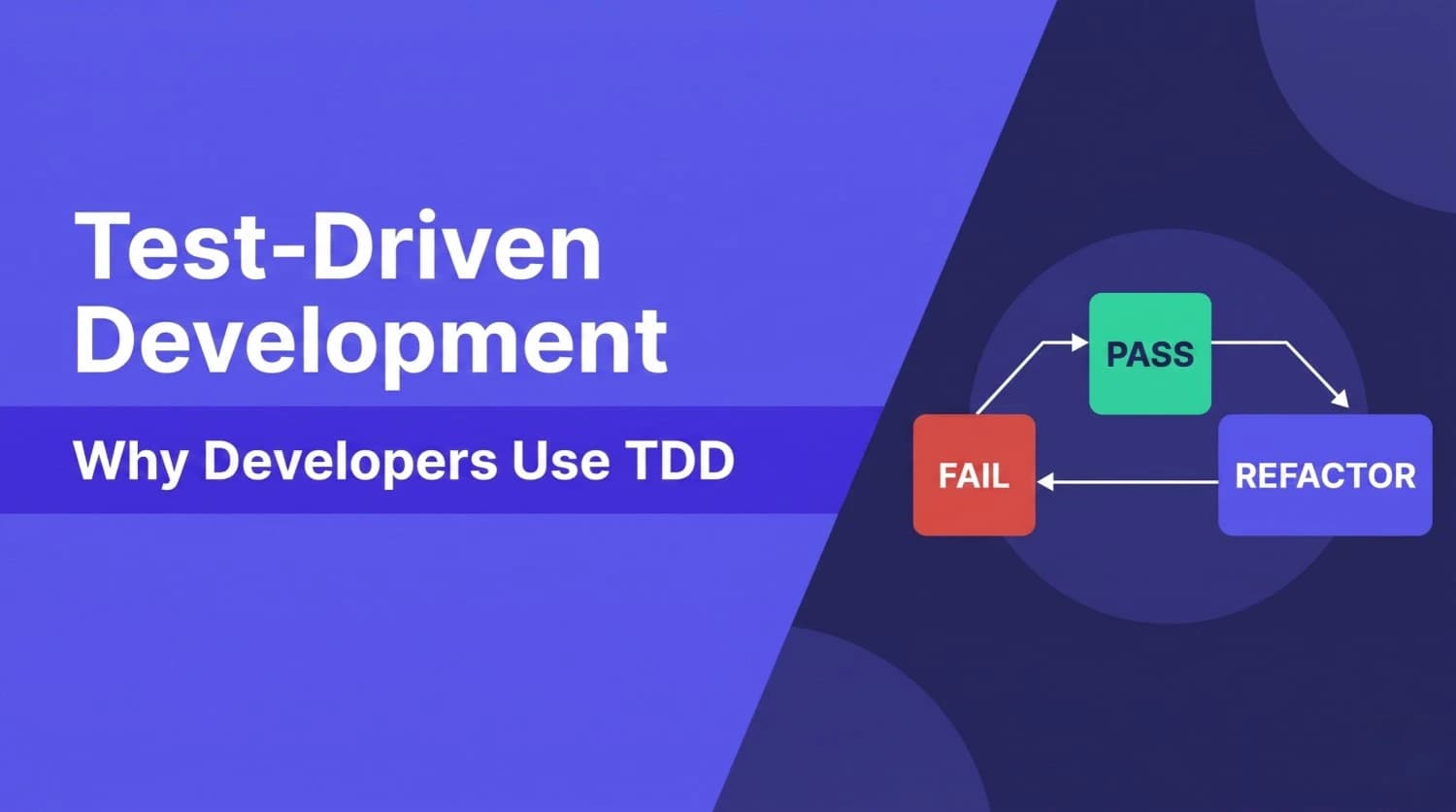
TDD is closely associated with Extreme Programming (XP) and is commonly described through three stages: Red, Green and Refactor.
Unlike conventional testing, where testing often happens after implementation, TDD makes verification an integral part of the coding process. The tests also help clarify requirements and influence how developers design their functions, classes and interfaces.
The TDD workflow follows a continuous cycle called Red-Green-Refactor. Developers repeat these stages for small pieces of functionality rather than waiting until an entire feature is completed.
Red: Write a Failing Test
The first step is to write a test describing what the application should do. Developers run the test before implementing the required functionality.
The test should fail because the expected behaviour has not been implemented yet. This confirms that the test can identify the missing functionality rather than passing without actually checking anything.
For example, imagine developing a registration system. A requirement states that users must provide a valid email address. A developer first writes a test to check whether an invalid email address is rejected.
Green: Write Code to Pass the Test
After confirming that the test fails for the expected reason, the developer writes the minimum production code necessary to make it pass.
The objective is not to build the entire feature immediately. Instead, developers focus on satisfying the specific requirement covered by the current test.
Once the test passes, they can move forward with another behaviour, such as accepting valid email addresses or rejecting empty inputs.
Refactor: Improve the Code
The final stage focuses on improving the implementation while preserving its existing behaviour.
Developers may remove duplicated logic, improve naming, simplify conditions or reorganize functions. They run the test suite again to confirm that these improvements have not introduced unexpected problems.
Refactoring is an essential part of TDD. Without it, developers may accumulate poorly structured code that technically passes tests but becomes difficult to maintain.
The cycle then repeats for the next requirement.
TDD is useful because it changes how developers approach requirements, implementation and software quality. Its benefits extend beyond identifying programming errors.
Detects Problems Earlier
When developers write tests before implementation, they can identify missing requirements and incorrect assumptions early.
For example, a payment calculation function might need to handle discounts, invalid amounts and rounding rules. Writing tests for these conditions before implementation makes the expected behaviour clearer.
Finding problems during a small development cycle can also make debugging more focused because developers are working with a limited amount of recently changed code.
Reduces Regression Risks
A regression occurs when a new code change unintentionally breaks functionality that previously worked.
TDD creates a growing collection of automated tests that developers can execute whenever they modify the application. These tests provide an early warning when an existing behaviour stops working.
This is particularly useful in applications with frequent updates, multiple developers and complex business logic.
Encourages Better Software Design
Writing tests first forces developers to consider how a piece of functionality will be used before deciding how to implement it.
If a function is difficult to test independently, its design may contain unnecessary dependencies or tightly connected responsibilities.
This encourages developers to create smaller, more focused components with clearer interfaces. However, TDD does not automatically guarantee good architecture; thoughtful design decisions are still necessary.
Improves Code Maintainability
Software projects change continuously. Developers add features, modify existing logic and fix defects as business requirements evolve.
A meaningful test suite documents expected behaviour and helps developers understand how different parts of an application should respond to specific inputs.
This makes future modifications more predictable, particularly when working with code originally written by another developer.
Supports Faster Feedback During Development
Automated tests provide immediate feedback without requiring developers to manually repeat every verification step.
When a small change causes a failure, developers can investigate it before moving to unrelated tasks.
This does not mean TDD always reduces total development time. Writing and maintaining tests requires effort, but the feedback loop can make changes easier to verify throughout a project's lifecycle.
Consider a simple function that calculates the final price after applying a discount.
The requirement is straightforward: a product costing $100 with a 10% discount should have a final price of $90.
A developer following TDD would begin by writing a test that expects the calculation to return 90.
The test initially fails because the discount calculation has not been implemented. The developer then creates the function to calculate the discounted price.
After the test passes, additional tests can cover important conditions:
A product with no discount should retain its original price.
A 50% discount should reduce the price correctly.
A negative product price should be rejected if the business rules prohibit it.
A discount outside the permitted range should be handled appropriately.
The developer can then refactor the implementation while repeatedly running the tests.
This example demonstrates how TDD turns requirements into executable checks instead of relying entirely on manual verification.
The main difference between TDD and traditional test-after-development workflows is the order in which implementation and testing happen.
Comparison | TDD | Traditional Test-After |
Testing sequence | Tests before implementation | Tests after implementation |
Development focus | Behaviour and requirements first | Implementation first |
Feedback | During each development cycle | Often after coding |
Design influence | Tests help shape interfaces | Design may precede tests |
Regression protection | Built progressively | Depends on the test strategy |
Both approaches can produce reliable software. TDD is a development technique, not a replacement for integration testing, system testing, security testing or manual exploratory testing.
Even when developers understand the Red-Green-Refactor cycle, poor implementation can reduce its effectiveness.
Writing overly complex tests: Tests should focus on one clear behaviour and remain easy to understand.
Skipping the refactoring stage: Passing tests do not automatically mean the code is clean or maintainable.
Testing implementation details: Prefer verifying observable behaviour rather than internal methods or unnecessary technical details.
Ignoring edge cases: Include relevant boundary conditions, invalid inputs and error scenarios.
Depending entirely on unit tests: Unit tests cannot replace integration, performance, security and end-to-end testing.
Developers can make TDD more effective by starting with small, clearly defined requirements and selecting meaningful test cases.
Keep unit tests fast, isolated and repeatable. Avoid unnecessary dependencies on databases, external services and file systems when testing individual units.
Use descriptive test names that communicate the scenario and expected result. Organize tests so failures are easy to understand and investigate.
Finally, integrate automated test execution into the development workflow or CI pipeline. This helps teams identify failures consistently as code changes move through development and review.
TDD is not equally suitable for every development task.
It can be difficult to apply when requirements are unclear, expected behaviour changes frequently or developers are experimenting with an unfamiliar technology. In these situations, exploratory coding or a prototype may help establish the requirements before introducing a structured test-first workflow.
It can also be challenging when working with highly visual interfaces, hardware-dependent functionality or complex external integrations. Developers may need a combination of unit, integration, component and end-to-end testing instead of relying exclusively on TDD.
The goal should be selecting a testing strategy that matches the project's risks and requirements, not following a development methodology simply because it is popular.
1. What is the main purpose of Test-Driven Development?
The main purpose of TDD is to guide software implementation through tests written before production code. It helps developers define expected behaviour, detect problems early and maintain confidence when modifying existing functionality.
2. What are the three stages of TDD?
The three stages are Red, Green and Refactor. Developers first write a failing test, implement the minimum code needed to pass it, and then improve the code while ensuring that the tests continue to pass.
3. Is Test-Driven Development better than traditional testing?
Neither approach is universally better. TDD provides continuous feedback and encourages testable designs, while traditional test-after-development workflows may be more practical for certain tasks. Both can contribute to reliable software when supported by an appropriate testing strategy.
4. Which programming languages support TDD?
TDD can be used with most programming languages that have suitable testing frameworks. Examples include JavaScript with Jest or Vitest, Python with pytest, Java with JUnit, and C# with xUnit or NUnit.
5. Does Test-Driven Development eliminate software bugs?
No. TDD helps identify defects in the behaviours covered by its tests, but it cannot guarantee bug-free software. Incomplete test cases, incorrect assumptions and untested integrations can still introduce defects. Additional testing and code reviews remain necessary.
Test-Driven Development gives developers a disciplined way to build and verify software functionality through small, repeatable development cycles. By writing tests first, implementing the required behaviour and refactoring continuously, teams can improve feedback, reduce regression risks and create more maintainable code.
However, TDD is not a universal solution or a substitute for comprehensive software testing. Its effectiveness depends on meaningful test cases, clear requirements and consistent implementation.
For developers building applications that need to evolve reliably, understanding and applying TDD can be a valuable addition to their software engineering practices.
Written by
Alaffiya Madarwala
Last updated
19 November 2026
