
Vibe Coding: The New Way to Build Software With AI
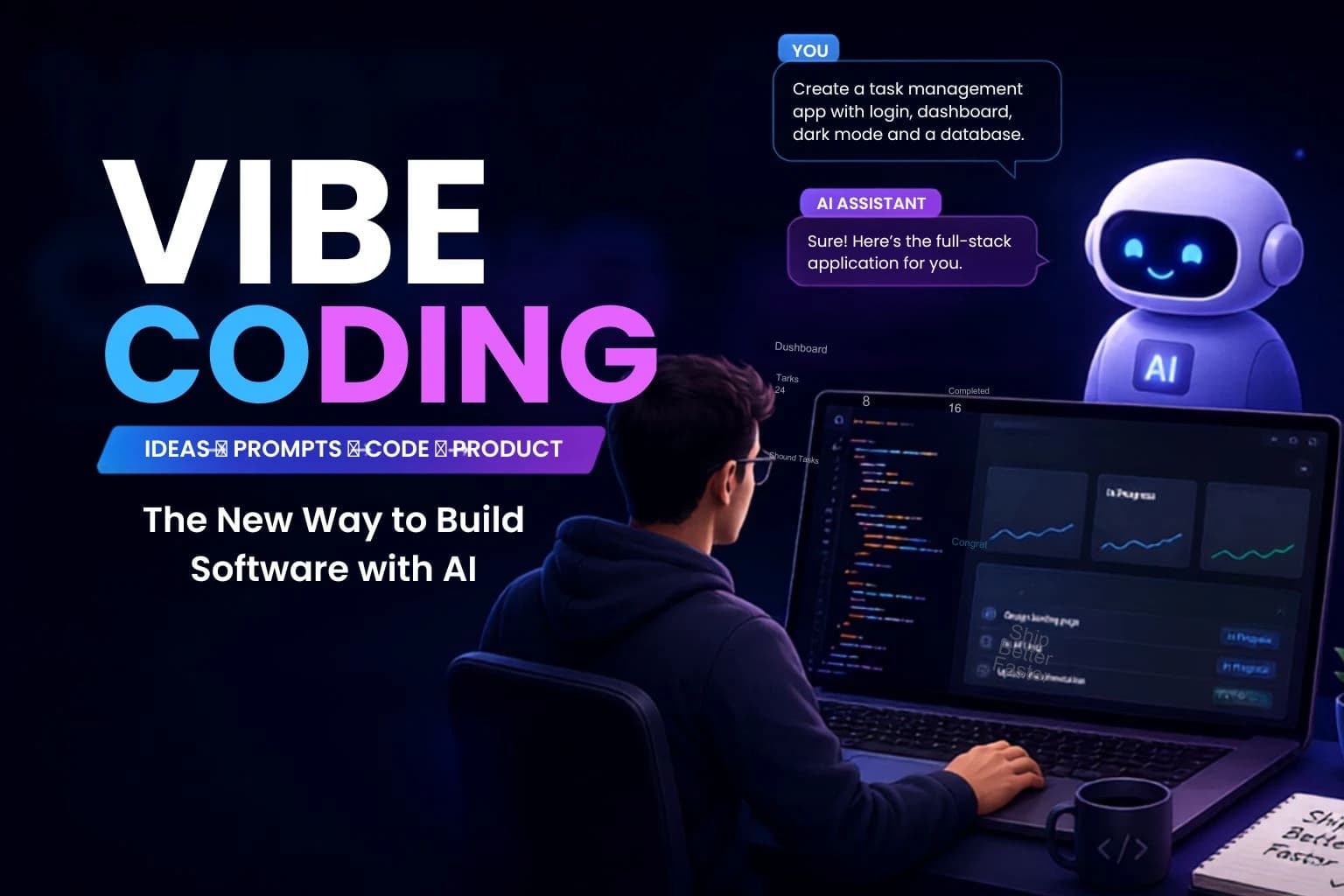
Imagine having an app idea but not knowing how to write hundreds of lines of code.
You describe what you want:
“Build me a task management app with login, dark mode, a dashboard, and a database.”
A few moments later, AI generates the application.
You test it.
It works.
You add another feature.
AI writes more code.
You fix an error by describing the problem instead of manually debugging every line.
This is the idea behind Vibe Coding—a new approach to software development where developers use natural language and AI coding tools to turn ideas into working software much faster.
But there is an important catch.
Vibe coding can make you dramatically faster, but it can also make you dramatically careless.
The difference depends on how you use it.
What Is Vibe Coding?
Vibe coding is a style of software development where you describe what you want an AI coding assistant to build, modify, or fix, rather than manually writing every piece of code yourself.
Instead of starting with:
Write the HTML.
Write the CSS.
Create the API.
Connect the database.
Build the authentication.
You might tell an AI:
“Create a responsive dashboard where users can view their orders, filter them by status, and export the results as CSV.”
The AI generates the initial implementation.
You then review it, test it, provide feedback, and continue iterating.
The important idea is that natural-language instructions become part of the development workflow.
Why Vibe Coding Became So Popular
Traditional development can involve a lot of repetitive work.
Developers may spend hours creating:
Boilerplate components
CRUD APIs
Database models
Form validation
Unit tests
Documentation
Configuration files
Basic UI layouts
AI can generate much of this starting code quickly.
This changes the developer's role.
Instead of spending all their time typing code, developers can spend more time thinking about:
What should we build?
Why should we build it this way?
Is the architecture correct?
Is the application secure?
Does it actually solve the user's problem?
That's where vibe coding becomes powerful.
Vibe Coding vs Traditional Coding
Traditional Development | Vibe Coding |
|---|---|
Developer writes most code | AI generates much of the code |
Syntax knowledge is critical | Problem description becomes important |
More manual boilerplate | Faster generation |
Debugging is mostly manual | AI can assist debugging |
Developer controls every line | Developer reviews generated output |
Usually slower initially | Extremely fast prototyping |
However, this doesn't mean traditional programming is becoming useless.
Quite the opposite.
The more complex the application becomes, the more important software engineering knowledge becomes.
The Biggest Advantage: Speed
Suppose you want to build a simple landing page.
Traditionally, you might spend hours creating the layout, responsive CSS, components, animations, and forms.
With an AI coding tool, you can describe the design and get a working first version much faster.
You can then say:
“Make the hero section more premium.”
Then:
“Improve mobile responsiveness.”
Then:
“Add a pricing comparison section.”
Then:
“Make the animations subtle.”
This creates a conversational development loop.
Prompt → Generate → Test → Review → Improve
That cycle is at the heart of vibe coding.
But Here's Where Vibe Coding Goes Wrong
The biggest mistake is assuming:
“If the AI generated it, it must be good.”
It isn't.
AI can generate code that looks impressive while containing serious problems.
For example:
Weak authentication
Exposed secrets
Poor database queries
Security vulnerabilities
Duplicate logic
Unnecessary dependencies
Poor error handling
Incorrect business logic
Bad accessibility
Difficult-to-maintain architecture
A prototype might work perfectly while still being completely unsuitable for production.
Vibe Coding Is Excellent for Prototypes
This is where vibe coding really shines.
Imagine you have a startup idea.
Instead of spending two weeks building a prototype, you can create a working version much faster.
You can test:
User flows
UI ideas
Product concepts
Business assumptions
Feature ideas
Customer feedback
This means you can validate an idea before investing heavily in development.
For entrepreneurs and small teams, that's extremely valuable.
Where You Should Be Careful
Vibe coding becomes risky when the application handles sensitive information.
Be especially careful with:
Authentication
Never blindly accept AI-generated authentication logic.
Payments
Payment systems require careful validation, security, and reliable transaction handling.
Personal Data
Don't casually expose user information through APIs or logs.
Database Operations
AI-generated queries may work but perform badly at scale.
Security
Always review authentication, authorization, input validation, file uploads, and API permissions.
The Best Way to Use Vibe Coding
Don't treat AI as your programmer.
Treat it as your development partner.
A strong workflow looks like this:
Step 1: Explain the Goal
Tell the AI what you're actually trying to build.
Step 2: Define Requirements
Specify:
Users
Features
Technology
Data
Permissions
Expected behavior
Step 3: Build Small Pieces
Don't ask AI to create an entire production application in one prompt.
Build it feature by feature.
Step 4: Review the Code
Ask:
Why did you implement it this way?
What are the security risks?
What happens if the request fails?
Step 5: Test Everything
Test:
Happy paths
Invalid inputs
Empty states
Authentication
Permissions
Mobile layouts
API failures
Edge cases
Step 6: Refactor
AI-generated code often needs cleanup.
Remove:
Duplicate functions
Unused dependencies
Dead code
Unnecessary complexity
A Simple Example
Instead of asking:
“Build an e-commerce website.”
Give the AI a structured requirement:
“Create a Next.js e-commerce application using TypeScript. Build the product listing first. Add filtering by category and price. Use reusable components. Validate query parameters. Keep the API layer separate from UI components. Include loading, empty, and error states.”
That's a much better instruction.
Why?
Because you're giving the AI constraints and architecture, not just a vague idea.
Vibe Coding Does NOT Mean You Don't Need to Learn Programming
This is one of the biggest misconceptions.
If you don't understand programming, you may not recognize when AI produces bad code.
You might see:
Application works.and assume:
Application is good.Those are completely different things.
A developer who understands JavaScript, databases, APIs, HTTP, authentication, security, Git, and system architecture can use AI much more effectively.
The goal isn't to stop learning code.
The goal is to use AI to multiply your coding ability.
Skills Developers Should Build in the Vibe Coding Era
You don't necessarily need to memorize every syntax detail.
But you should understand:
Programming fundamentals
Data structures
APIs
Databases
Git and GitHub
Authentication
Security
Testing
Debugging
System design
Cloud deployment
Software architecture
And most importantly:
Learn how to read code.
If AI writes 500 lines of code for you, you should be capable of understanding what those 500 lines are doing.
Common Vibe Coding Mistakes
1. Building Everything With One Prompt
Large prompts often create messy applications.
Build incrementally.
2. Copying AI Code Without Understanding It
This creates technical debt very quickly.
3. Ignoring Security
A functional application isn't automatically a secure application.
4. Adding Too Many Libraries
AI may introduce dependencies that aren't actually necessary.
5. Never Refactoring
Fast generation can produce duplicated and inconsistent code.
6. Skipping Tests
AI can generate code that works in one scenario and fails in another.
7. Letting AI Make Every Architectural Decision
You should remain responsible for the application's architecture.
The Future of Vibe Coding
Vibe coding is likely to become a normal part of software development.
Developers will increasingly work at a higher level of abstraction.
Instead of thinking only about:
“How do I write this function?”
they'll think about:
“What should this system do, and what's the safest way to implement it?”
AI will handle more boilerplate.
Developers will increasingly focus on:
Architecture
Product thinking
Security
Testing
Performance
User experience
Business logic
Code review
In other words, AI may reduce the amount of code developers need to type without reducing the need for developers who understand software engineering.
Final Thoughts
Vibe coding isn't the end of programming.
It's a change in how programming is done.
The biggest opportunity isn't simply being able to generate an application with AI. It's being able to combine human judgment + software engineering knowledge + AI speed.
Use AI to create the first version.
Use your knowledge to question it.
Use testing to challenge it.
Use engineering principles to improve it.
That's the difference between AI-generated code and AI-assisted software engineering.
And that difference will matter more than ever as vibe coding becomes part of everyday development.
Written by
Praxiaskill
Last updated
8 August 2026
