
What Is Multimodal AI?
Have you ever tried explaining a complex visual bug in your website design or a messy spreadsheet layout to an AI chatbot by typing long, frustrating paragraphs, only to wish you could just upload the screenshot and talk to the assistant out loud?
For years, artificial intelligence lived in isolated silos. Text models could read, vision models could look at pictures, and audio tools could transcribe speech—never the two shall meet.
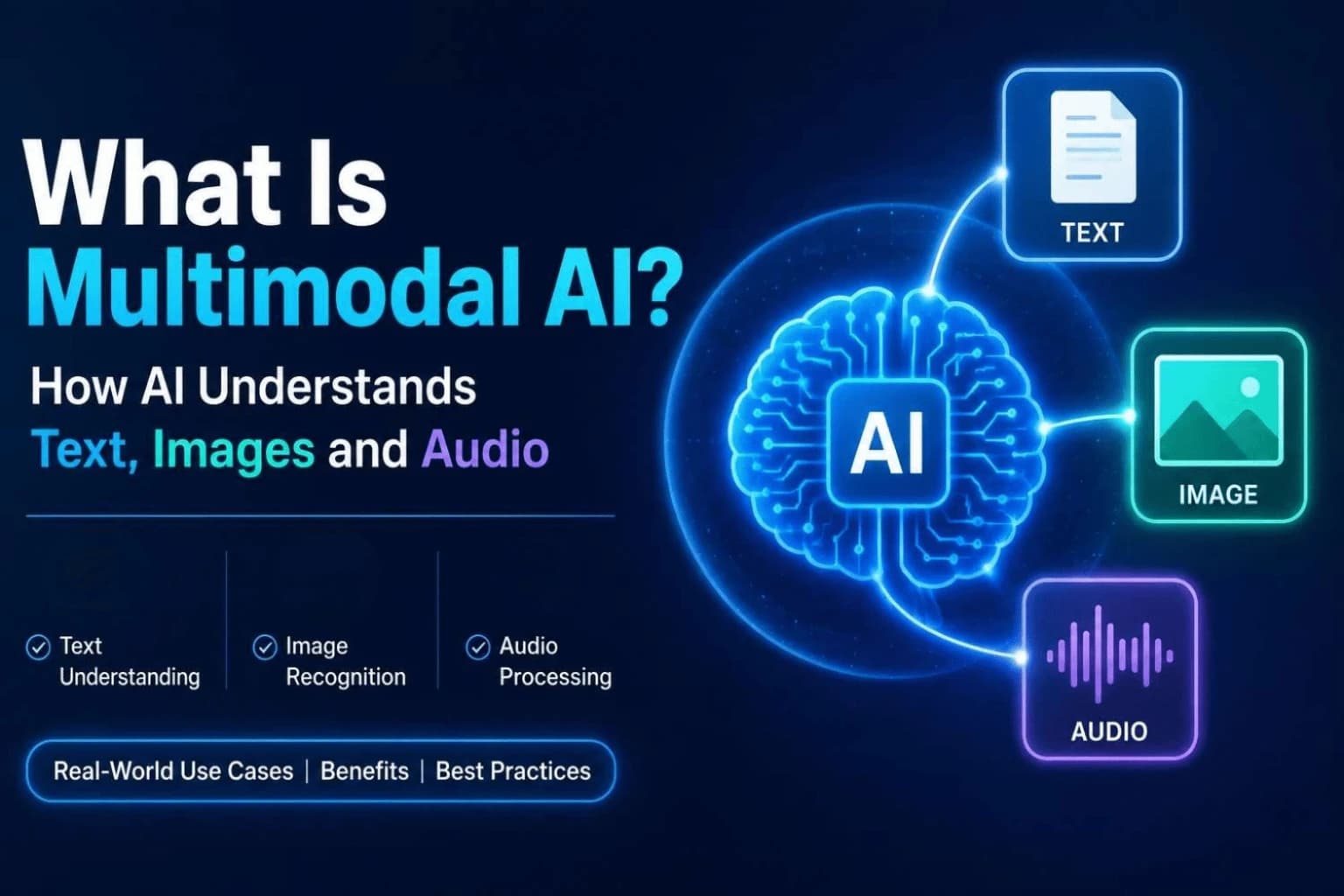
Understanding What Is Multimodal AI? How AI Understands Text, Images and Audio reveals how modern intelligence has broken down those barriers. Let's look at how unified models process multiple sensory streams at once to mimic human-like perception.
Traditional large language models were strictly text-bound. If you wanted an AI to review a graphic, you had to translate every color, shape, and pixel coordinate into descriptive text tokens.
That translation layer created massive friction, lost data nuances, and made real-time collaboration nearly impossible. True multimodal AI eliminates that middleman by allowing models to natively "see" images, "hear" voice inflections, and "read" written context together.
Multimodal AI refers to advanced machine learning architectures trained to process, integrate, and reason across multiple types of data—known as modalities—at the same time.
Instead of treating an image as an alien object or audio as a text transcription, a multimodal network builds a holistic understanding of an interaction by combining visual shapes, spoken cadences, and written instructions into a unified stream of consciousness.
1. Dedicated Modality Encoders
Raw inputs are fed into specialized encoders. Text is tokenized into semantic word embeddings, images pass through Vision Transformers (ViT) to map spatial patterns, and audio waveforms run through speech recognition encoders to capture acoustic cues.
2. Feature Projection and Alignment
The abstract features from each encoder are projected into a shared numerical embedding space. This translation step ensures that a spoken word, a written sentence, and a visual icon occupy compatible mathematical coordinates.
3. Joint Transformer Fusion
A core transformer-based reasoning layer fuses these aligned representations together, letting the model weigh visual evidence against textual instructions before generating a coherent response.
Customer Support: Allowing users to upload a screenshot of an error code while speaking live to an agent, reducing troubleshooting times drastically.
Healthcare Diagnostics: Fusing medical imaging scans (X-rays and MRIs) with patient health history notes to assist clinicians with multi-angle context.
E-Commerce Visual Search: Letting shoppers upload photos of apparel items to find exact stylistic matches combined with text-based preference filters.
Common Mistakes
Ignoring Input Latency: Underestimating the preprocessing overhead required to encode high-resolution images or stream live audio tokens.
Overloading Context Windows: Cramming multi-megabyte video files and lengthy documents into a single prompt without managing token efficiency.
Failing to Test Edge Cases: Relying solely on clean studio images or perfect audio recordings during testing instead of real-world, noisy inputs.
Expert Tips
Leverage Native Integration Over Pipelines: Whenever possible, use models with native multimodal architectures rather than stitching separate speech-to-text and vision APIs together, which introduces cumulative errors and latency.
Optimize Image Resolutions Before Upload: Compress excessively large product photos or screenshots before feeding them into agent loops to speed up encoding times and reduce API costs.
Establish Cross-Modal Guardrails: Implement strict filtering on image and audio inputs to prevent prompt injection attacks hidden inside visual artifacts or audio metadata.
Frequently Asked Questions
What is multimodal AI?
Multimodal AI is an AI system that can process and connect multiple forms of information, such as text, images, audio, and video.
How does multimodal AI understand images?
Images are processed into machine-readable representations that can be connected with language and other information, allowing models to answer questions about visual content.
Can multimodal AI understand audio?
Yes. Multimodal systems can process spoken information and combine it with other modalities such as text and images.
Is multimodal AI better than text-only AI?
Not automatically. Multimodal AI is more useful when information from multiple modalities provides important context. For simple text tasks, a text-focused system may be sufficient.
What are the risks of multimodal AI?
Important risks include hallucinations, privacy concerns, bias, and errors caused by incorrectly interpreting or combining different types of information.
Conclusion
Understanding What Is Multimodal AI? How AI Understands Text, Images and Audio comes down to one central idea: AI is becoming better at working with different forms of information together.
Text provides words. Images provide visual context. Audio provides spoken information. Video can combine several of these at once. The real opportunity isn't simply giving AI more senses. It's teaching systems to connect those signals responsibly and accurately.
And that's also where the biggest challenge remains. Multimodal AI can produce remarkably useful results, but it still needs testing, verification, and thoughtful human oversight. The future of AI may not be about choosing between text, images, or audio.
It may be about understanding all three together.
Written by
Praxiaskill
Last updated
21 August 2026
